Doubling Down Against the Brokers

Fueled by stronger than expected earnings and a rising stock market the brokers have rallied by 15-20% since I mentioned that I was going to short them. However, my long-term view of the sector is unchanged. The economy will suffer a housing-led recession in 2007 that will hurt the brokers’ profits significantly. The current rise in their share prices could mean a greater fall once the stock market begins to decline.

Therefore, I am really attracted to the potential payoffs of shorting the brokers at current prices. I am currently short Lehman Brothers (NYSE:LEH) and Bear Stearns (NYSE:BSC). I will be doubling my short position in these stocks.

Gulf Countries and Their Surging U.S. Dollar Assets

When we think of countries that are hoarding US dollar assets the first country that pops to mind is China. But the increase in oil revenues in recent years has made the Gulf countries perhaps just as important in this regard. According to the Economist:

Counting only the Middle East oil exporters, the surplus has surged from $30 billion in 2002 to an estimated $280 billion this year. One reason why this gets much less attention than the smaller $160 billion increase in China is that only a fraction of it has gone into official reserves, which are publicly reported. Most of it is stashed in government oil-stabilisation or investment funds, such as the Abu Dhabi Investment Authority, which are much more secretive than the People’s Bank of China—but which probably hold just as many dollar assets.

gcc_current_account

The six members of the Gulf Co-operation Council, or GCC (Saudi Arabia, United Arab Emirates, Kuwait, Bahrain, Oman and Qatar) have fixed their exchange rates to the US dollar. As a result, they are unable to increase interest rates above the rate of inflation and cool down their over-heated economies.

As the Economist points out “only 10% of the GCC’s imports come from America (compared with one-third each from Europe and Asia), so from a trade-weighted point of view, the dollar peg makes no sense.” A more sensible approach would be to peg to a basket of currencies including the US dollar, Euro, several Asian currencies and gold.

Indeed the GCC is already moving towards this direction with the planned introduction of a new unified currency in 2010. Once established, the GCC leadership may decide to invoice their hydrocarbon sales in the new common currency, moving away from the current dollar pricing system. It could also become the reserve currency of choice for Islamic and Arab central banks for a combination of religious and political reasons.

All this could have severe ramifications for the US dollar. Currently, Asian central banks and Gulf countries are the major buyers of the US dollar. Any sort of reduction in this buying could cause the US dollar to tumble.

Predictions

Here are some predictions of mine that most people on Wall Street think are crazy:

  1. The economy will suffer a recession in 2007.
  2. House prices will fall in real terms through 2008.
  3. Gold will trade over $1000/ounce before end of 2008. (currently $621/ounce)
  4. S&P 500 will trade below 1000 before end of 2008. (currently 1409)
  5. 10-year bond will yield more than 6.5% before end of 2008. (currently 4.55%)

Let us see if any of these prove to be correct.

Increasing Subprime Mortgages Delinquencies

The WSJ reports that delinquencies on subprime mortgages have been increasing at a troubling rate recently.

Based on current performance, 2006 is on track to be one of the worst ever for subprime loans, according to UBS AG. “We are a bit surprised by how fast this has unraveled,” says Thomas Zimmerman, head of asset-backed securities research at UBS. Roughly 80,000 subprime borrowers who took out mortgages packaged into securities this year are behind on their payments, the bank says.

subprime_mortgage_delinquencies

The fact that borrowers with bad credit histories are now having a tough time making loan payments shouldn’t come as a complete surprise if we consider how the boom began:

The subprime industry’s current troubles can be traced back to 2003 and 2004, when defaults were unusually low. Investors who purchased these loans did well and were eager to buy more. That encouraged lenders to lower their standards, making loans to more people with low credit ratings. Lenders also grew less inclined to demand full documentation of income and assets and more willing to offer “piggyback” loans that allowed borrowers to finance 90% or 100% of the purchase price without being required to buy private mortgage insurance.

Many lenders kept introductory “teaser” rates low even after short-term interest rates began rising in June 2005, while increasing the amount the rate could rise on the first adjustment. That meant borrowers would face sharply higher costs when their monthly payments were reset.

The environment has changed over the past year with interest payments increasing for borrowers. And if they aren’t able to make their payments, they can’t sell their houses as quickly and for as much value as before.

The borrowers aren’t the only ones feeling the pinch in the subprime mortgage market:

If delinquencies continue to grow, the pain could also be felt by investors who have flooded into the market for subprime securities. Because of the way mortgage-backed securities are structured, investors who buy investment-grade securities aren’t likely to be hurt if losses are close to expectations. But if losses on the underlying mortgages substantially exceed expectations, some investors who buy the riskiest slices of subprime securities are likely to rack up losses. These include hedge funds and investors who buy collateralized debt obligations, pools of debt instruments that are often snapped up by foreign buyers.

There has been a bubble in subprime mortgage securities which was fueled by foreign governments wishing to invest their dollar reserves in debt instruments and by hedge funds who were engaged in the carry-trade. As delinquencies continue to soar it is reasonable to expect foreigners and hedge funds to pull out of the mortgage-backed securities market. This will force lenders to tighten their lending standards and cause a substantial decline in the volume of subprime mortgages. A fall off in mortgage activity will further hurt the housing market and, of course, the economy

Dubai – The Most Spectacular Place in the World

Last week during my return to Canada I got the chance to stopover at Dubai and spend a couple of days. It was my first trip to the city and I had high hopes after hearing a lot of good things about the place. Despite my expectations being sky high, Dubai managed to surpass it. The enormous development taking place is mind boggling and astonishing since Dubai is hardly ever mentioned here in the West.

Actually, Dubai is the last place in the world where you would expect this to be taking place. It sits in one of the most inhospitable climates with little rainfall and summer temperatures climbing over 120 degrees. Dubai is one of the 7 states of the United Arab Emirates. The UAE is surrounded by radically conservative Islamic countries.

Dubai was built on trade. Decades ago Dubai served as a transit hub — a stopping point for merchants on trade routes connecting the Gulf, Africa and the Far East. Oil is an important component in the economy, though much less than the other emirates. In fact, it is widely believed that Dubai will run out of oil in the next decade.

Sheikh Rashid bin Said Al Maktoum, the ruler of Dubai from 1958 to 1990, became famous for the risky decisions he made in the name of business. Recognizing that trade, and not oil, would be the engine for future growth, he ordered to dredge the silted-up Dubai Creek during the 1950s to allow easier access for trading vessels. In the late 1970s he decided to build the largest man-made port in the world. Both projects required heavy borrowing but they proved extremely successful over time.

This aggressive commitment to business would be adhered to by Dubai’s subsequent rulers. They have created a liberal destination with minimal taxes and regulations that has helped attract foreign investment.

Another of Dubai’s advantages is the availability of cheap labor that predominantly comes from the Indian sub-continent. The laborers often work long hours doing grueling work for hardly $200-300 a month. But as someone who has lived in the Indian sub-continent, I can assure you that most of them are getting a better deal than they would get at their native places.

Dubai’s open-door policy with regards to foreigners has transformed it into a multicultural society with the local Emiratis composing only 10% of the population with the rest made up of expatriates of numerous nationalities, though the majority are from India. Expatriates have little hope of achieving citizenship though there is discussion taking place of granting citizenships to those who have made Dubai their residence for at least 20 years.

Dubai’s rapid growth has provided a windfall for local Emiratis and should ensure their support for the ruling family’s pro-business stance. With their support Dubai will enjoy social stability for the foreseeable future.

Along with its world-class maritime facilities, Dubai has nurtured a thriving tourism industry and a dynamic real estate sector. Some of the projects completed and under development that will enhance the growth in these sectors are:

  • Palm Islands – To deal with running out of beaches, Dubai is building out more coastline. Palm trees, The World, and a crescent the size of Manhattan are taking shape off Dubai’s coast requiring the reclamation of 3.5 billion cu. meters of earth to create 1500 km of beach front where there once was only 67 km. The projects will be visible from space and house over 1.5 million people.
  • Burj Al Arab – Opened in 1999 and labeled as the world’s only seven-star hotel, it symbolizes Dubai’s glitz and glamor.
  • Burj Dubai – Slated to be world’s tallest building when completed in 2008. The final height is a closely guarded secret, though speculation is that it will be 800m high, out distancing the current record holder Taipei 101 by 300m. The world’s largest shopping mall is also being constructed next door.
  • Dubai Land – The ultimate destination for entertainment, leisure and tourism. Expected to be three times the size of Disneyland and will be completed by the end of this decade.
  • Dubai World Central International Airport – A second facility currently under construction that will have the capacity to rival Chicago’s O’Hare and London’s Heathrow.

With all these mega-projects the place is full of construction activity. In fact, 20% of the world’s industrial cranes and over 80% of the world’s dredgers are said to be in Dubai these days.

Although Dubai has already positioned itself as a major tourist destination, the emirate’s long-term goal is to increase the number of tourists from 6 million in 2005 to 15 million in 2010. During my visit I got to experience beautiful beaches, the Burj Al Arab, a cruise along the creek, a desert safari, an indoor ski slope and tax free shopping. In the coming years numerous other attractions will be available.

Being a gold bug, I should mention that Dubai is nicknamed “The City of Gold” because of its position as a huge retail market for gold. It is estimated that each year 20% of the world’s gold production passes through Dubai. The city’s popularity as a gold market is due to the fact that there are no taxes and easy import procedures. If you are planning to make a major jewelry purchase this is the best place to do it.

Having been impressed with the place, I inquired about buying an apartment which could include a residence visa. Unfortunately, property prices have sky rocketed in recent years with lots of speculators entering the market and my contrarian instincts prevent me from buying an asset when it is popular. Although currently demand is outstripping supply, it seems almost daily there is an announcement of a new property launch. I am no expert in real estate investing but I can see a significant risk of an inventory build up particularly if Dubai’s population does not grow as fast as expected.

Nonetheless Dubai is the place to be in and it will not stay off the radar screens for long. The emirate has managed to prove that a completely free society with protected property rights is the best way that a country can become prosperous. Other countries in the world better emulate the Dubai example or be left behind.

The Coming Bear: Stock Market Crash (Part 4)

In the last post of this series, The Coming Bear, I discussed the reasons why I believed the economy was headed for a housing-led recession in 2007. If this turns out to be correct the stock market is going to fall dramatically and will probably challenge the 2002 lows.

Even if I am wrong and the economy continues to grow at its current pace with corporate earnings rising along with it, the stock market is overvalued by almost every measure:

  • P/E ratios are well above the historical average of about 15. Typically the beginning of a bull market is signaled when P/E ratios fall below 10. Currently, the S&P has a P/E ratio over 18.
  • The Dow/Gold ratio currently trades at 19. This ratio has equaled 1 a few times in the past which made for a great time to buy the Dow and sell gold. Right now gold is the better buy.
  • The Dow dividend yield stands at 2.17% which is less than half of the yield on the 10-year treasury. Many times in the past Dow stocks were yielding over 5%

For these reasons it is very hard to imagine that stocks will produce above average returns in the future. Now if I am correct and the economy does suffer a housing-led recession and earnings do fall, then we could see stock prices get hit very hard.

Almost all sectors of the stock market should be negatively affected including retailers, technology, transports, financials, commodities, and of course real estate. Only gold stocks will be spared since their performance depends not on economic growth, but on monetary and foreign exchange conditions.

If you really want to protect yourself from the coming bear market, the best strategy is to sell all of your stocks. Now this may sound heretical to you since you have always heard that stocks are the best performing asset class over the long term. But this depends on what is defined to be long term.

Consider that from 1968 to 1979 the best performing asset was gold which increased 19.4% annually. Stocks on the other hand gained only 3.1%. If you owned stocks during this period you actually lost money since inflation was running at 6.5%.

I am not sure how you feel, but I feel 10 years is a long time and I would hate to lose my money over so many years. So it is possible stocks can perform very badly for a long time. As discussed in this series of posts I believe we are in such a period. The bear market began in 2000 and should last for around 10 years. If you want to preserve your investments for the rest of this decade do the most logical thing… sell your stocks!

The China Growth Myth

china_cartoon

The Chinese growth story has received an enormous amount of press in recent years. Indeed, after a lull during the late nineties, China’s economy began to accelerate growth in 2002 and has been averaging 10% since then. It is now the 4th largest economy in the world after US, Japan and Germany.

There were two factors that triggered the economy’s emergence in 2002. First, China joined the WTO just a year earlier. Second, US consumer spending started to rebound after a brief recession. As a result, Chinese exports which were already high began to sky rocket.

china_trade_balance

The US is China’s largest export market accounting for 60% of its total exports or 6% of GDP growth. But we are now starting to see the US economy slow down. If the U.S. were to fall into a recession, how much of a negative impact would this have on China? Not much if you listen to the China bulls who argue that it is internal demand that has been fueling China’s growth.

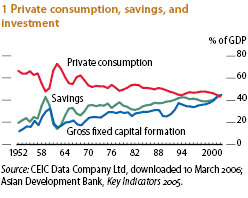
Though consumer spending has been growing, it has not kept pace with export growth. The following graph depicts consumption’s declining share of the economy:

china_consumption_share_gdp

Also note from the graph that capital investments have surged along with exports and now constitute the largest source of demand for the economy. But most of these investments have been allocated to building infrastructure to expand the manufacturing sector. Therefore, China’s investing boom is dependent on a healthy export environment. A decline in exports would lead to overcapacity, lower profits, and widespread bankruptcies.

The bottom line is that China has become the manufacturer for the US. Trade between the two countries has reached an unprecedented level and both are very dependent on each other. China needs healthy consumer spending in the US to keep its factories busy. The US needs China’s cheap goods and savings to finance purchases.

But when the US eventually falls into a recession expect China’s growth of exports and investments to decline. The economy will decelerate to low-single digit growth or, possibly negative growth. However, China’s huge foreign exchange reserves should serve to cushion the economy from any protracted slowdown.

Though I am bearish on China for the next few years, I am bullish in the very long term. The government’s economic liberalization is at an early stage with many reforms still needed. In the coming decades, China should experience greater growth than the West. In fact, 50 years from now don’t be surprised to see China enjoying the same status in the world as the US does today! But for the time being my money is out of China.

How Much Does Housing Wealth Boost Consumption?

No one will debate whether increasing home prices have had a positive effect on consumer spending. But there is considerable debate on how significant this effect is. I am in the camp that believes that the housing boom was the main contributor to consumer spending since 2001.

Last week’s Economist highlights a new study that estimates that each dollar increase in house prices eventually boosts consumer spending by 9 cents rather than 3 to 5 cents as widely thought. This implies that a loss of $1 trillion in housing wealth — which is how much housing wealth increased annually in recent years — would cause consumption to decline by $90 billion or three-quarters of a percentage point from GDP.

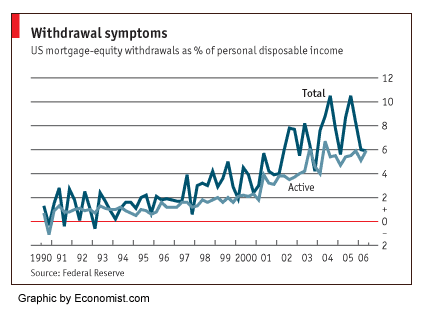
hew_income

In addition, as the housing slump worsens we can expect massive unemployment to hit construction workers, real estate agents, mortgage brokers, etc. This will lead to a substantial loss of income and consumption which should cause GDP to fall by much more than three quarters of a percent.

Marc Faber Turns Bullish on U.S. Large Caps

MarketWatch has noted that famed contrarian investor, Marc Faber (whose writings I regularly read), has shifted to favoring U.S. large cap stocks over emerging market equities.

He reasons that U.S. consumers may continue to spend despite a weakening housing market for the following reasons:

  • The Fed won’t allow the housing market to collapse and will provide as much liquidity as needed.
  • Home equity withdrawals continue to be popular.
  • Employment is high and wages are rising.
  • Falling commodity prices will put downward pressure on consumer prices.

Based on this, Faber goes on to say:

Whereas I am very negative in the long run, and I believe that the U.S. economic imbalances are not sustainable, for the next few months the investment community is too negative on the U.S. economy which is more likely to surprise to the upside than the downside.

The current global economic cycle is growing old by historical standards and there are signs of a slowdown. Therefore, Faber believes speculative buying in commodity and emerging markets which caused them to outperform U.S. equities, may reverse as investors sell off high-risk stocks and seek the safety of U.S. large caps.

Faber also likes tech stocks because technology has underperformed for several years now and “near-term money could shift out of oil and resource stocks and into tech stocks significantly.”

I should point out that this is just his outlook for the next few months and longer-term he remains very much bearish on the U.S. economy and the stock market:

I don’t think there is an option but to print money in the long run. If debt growth doesn’t continue to accelerate then the whole system collapses; my view is that we are going to see inflation rates in future that are beyond your imagination and in this environment.

I agree with his long-term view and feel owning gold and shorting stocks will be the most profitable strategy in such a scenario.

While Faber’s short-term bullishness on stocks could prove to be correct, I am not a trader and do not try to time the markets. The bottom line is that the U.S. is due for a recession and stocks are overvalued.

If the markets continue to rally I will increase my shorts. I don’t know when stocks will fall, but I am confident that a short position in a general basket of stocks today will turn out to be very profitable 12-24 months down the road.

Don’t Let the New Home Sales Data Fool You

The headlines on reports of the new home sales data highlight the fact that sales unexpectedly increased by 4.1%, the largest rise in 5 months.

Now before you get excited that the housing market may be stabilizing let me point out some things that I found from looking directly at the data:

  1. Sales in May, June and July were revised sharply lower.
  2. The median sales price of a new home fell 1.3% year-on-year, the first year-on-year decline since 2003.
  3. The housing data is subject to large statistical errors. The standard error is so high, in fact, that the government cannot be sure sales increased at all in August. The 4.1% increase is statistically meaningless.
  4. It can take up to six months for a trend in sales to emerge. New home sales have averaged 1.082 million per month over the past six months, up slightly from 1.080 million in the six month period ending in July — basically flat.

If new home sales really did increase, I attribute it to builders who are cutting prices and offering massive incentives in order to reduce inventory.

The market and media seem to be focusing on the headline number and pushing stocks higher. But the facts above suggest that the new home sales data does nothing to prove that housing has recovered. To reach such a conclusion we would need look at more data.