Will the Subprime Turmoil Spread Upwards

While the recent rise in defaults on subprime mortgages has become front page news, the most common viewpoint is that this will not have a significant impact on the economy since prime and Alt-A mortgages represent 45% and 20%, respectively of all mortgages outstanding and we are yet to see significant defaults in theses loans.

The source of the problem is that about 80% of subprime mortgages today — many of which were taken in the last few years — are adjustable-rate mortgages (ARMs) that have been nicknamed “exploding ARMs” because they have low fixed-interest payments in their first few years but then usually adjust to higher interest payments. Many of the sub-prime mortgages which were taken during the last few years have recently reset at higher rates leading to a rise in bad loans.

As many as 30% of the prime and 60% of the Alt-A mortgages taken out in the last few years were also ARMs. However, they have longer reset periods — 2 years or more — than subprime, which means we have yet to see the impact of higher payments on this segment of borrowers.

Already we are seeing seeing higher delinquency rates among prime borrowers, although not yet at alarming rates. 2.57% of all prime mortgages are now delinquent compared to 13.3% for subprime, according to the Mortgage Banking Association. Since almost half of all mortgage originations are prime, only a small rise in default rates is required to cause severe financial loss.

The reason many subprime borrowers are defaulting is the lax lending standards which allowed people to get mortgages who never should have. The lenders did not mind because there was a huge demand for mortgage-backed-securities (MBS) from investors. Common sense suggests that this insatiable hunger for MBS surely would have caused lenders to be similarly liberal when it came to originating prime and Alt-A mortgages.

That is, the current Alt-A borrowers probably would have been classified as subprime, and prime borrowers as Alt-A in the past. Thus, there is a substantial risk that the default rates for these mortgages could rise to significantly high levels, similar to what we are now seeing in the subprime group.

Protecting My Portfolio From a Crash

I believe the recent global equity sell-off may have marked the beginning of a period of much greater volatility. If so, the possibility of some sort of violent financial crash cannot be ignored. The world has been flush with liquidity originating from the US trade deficit and the yen carry trade; this has encouraged extreme speculation in asset markets.

The present environment of indifference to risk rarely reverses in an orderly manner. Seemingly mild negative news could set off a positive feedback loop that drives investors to sell.

Here are some possible events which elicited little fear from investors in the recent past, but in the present environment could spook investors enough that they regain their appreciation for cautiousness:

  • the introduction of capital or currency restrictions by some government in a major emerging market
  • a financial accident in the subprime lending or derivatives market
  • a major corporation declaring bankruptcy
  • a large multi-billion dollar hedge fund blowing up
  • a natural disaster
  • the outbreak of a deadly disease
  • an escalation of geopolitical tensions or a terrorist attack

My intention is not to scare people, but to warn investors of a higher than normal probability of significant near-term financial loss. I have prepared my portfolio by selling some of my gold stocks and shorting brokers, commodity producers and emerging markets. However, I wouldn’t recommend this strategy to others. The easiest way most people can protect their portfolios is by selling some of their assets and keeping cash and physical gold.

Japanese Individuals Getting In on the Yen Carry Trade

The WSJ reports that Japanese individuals are engaging in the yen carry trade, too.

Now people such as Naomi Kashiwazaki, 29 years old, have joined the fray. She trades currencies from her small apartment in Tokyo’s suburbs. She started about a year and a half ago to supplement the income from her online store, which sells designer athletic shoes that are hard to find in Japan. In recent months, she has earned an average profit of $8,600 a month.

“I must say, I am addicted to this now,” she says.

Tens of thousands of other investors like her are doing the same thing. With Japanese interest rates hovering at a low 0.5%, they borrow big piles of yen cheaply and then invest it in currencies elsewhere, looking for higher returns. Ms. Kashiwazaki makes trades totaling $200,000 or so a day among several currencies, ranging from the U.S. dollar to the Swiss franc.

As the yen gyrated over the past week, traders such as these are believed to have played a major role in the volatility. Last week, the yen gained 3.5% against the dollar.

“Japanese individuals are doing essentially the same thing as hedge funds,” says Tohru Sasaki, chief foreign-exchange strategist at J.P. Morgan Chase Bank in Tokyo. “Together they are acting like an enormous hedge fund.”

A combination of technology, deregulation and low interest rates is enabling individual Japanese to use the same kind of investment techniques as the pros. Borrowing money to trade currencies has become so popular in Japan that individual traders — sitting at their computers in homes across the country — now trade tens of billions of dollars a day, according to some estimates.

J.P. Morgan strategist Mr. Sasaki estimates that in the months leading up to last week’s sharp movements, Japanese individuals some days held foreign currency valued at more than five trillion yen, or $43 billion. That is similar to his estimate for the amount of yen loans taken out by professional investors in order to speculate in foreign currencies.

I have written before about the significance of the yen carry trade. This article supports my argument by showing how widespread it has become.

The US Trade Deficit as a Source of Global Liquidity

I have discussed before the importance of the yen carry trade for pumping liquidity into financial markets worldwide. But the US trade deficit may be a far greater source of easy money. The entire yen carry trade is widely estimated to be worth $200 billion. Compare this to the US trade deficit which is running at $800 billion per year.

Since many Asian countries devalued their currencies in the late 90’s, it has been much cheaper for US consumers to buy goods and services from Asia rather than from domestic suppliers. Currently, the US imports almost double of what it exports. If Asian exporters were to use their US dollar proceeds from sales and exchange it for their own currencies, their currencies would rise in value against the US dollar until trade between the countries balanced.

Instead, Asian central banks are currently intervening in foreign exchange markets by purchasing dollars from exporters at a rate that significantly undervalues the domestic currency. In effect, more domestic currency is being printed and traded for each dollar exporters earn than would have been the case had the foreign exchange market been more flexible. This causes the money supply in Asian countries to expand at a much faster pace.

Asian central banks use the dollars they have received to buy US-denominated assets, particularly debt. This has put downward pressure on US interest rates and stimulated greater lending, thereby increasing the money supply in the US as well. Much of the borrowed money is spent by US consumers to purchase more goods from Asia, resulting in a continuous cycle of money creation. Greater liquidity in Asia and the US spills over into other regions of the world via investments and trade causing liquidity to rise everywhere.

I outlined the effects of a potential unwinding of the yen carry trade in strengthening the yen, and weakening all other currencies and assets worldwide such as equities, real estate, commodities, gold, art, etc.

The unwinding of the US trade deficit will cause the US dollar to depreciate relative to Asian currencies such as the renminbi and yen. Also, declining liquidity will cause asset prices to fall. However, the US dollar gold price should do very well due of its inverse relationship to the US dollar.

What will cause an unwinding of the US trade deficit? One possibility is a slow down in US consumption arising from a collapse of the housing market. A robust housing market was integral to the economic recovery since 2002 creating employment and allowing households to cash-out their rising home equities. However, housing starts and home prices have been falling in the last year. This will eventually negatively impact the employment market and mortgage equity withdrawals causing consumption to decline, too.

Another possibility is Asian central banks, namely China, reducing their US dollar purchases in response to intense pressure from Washington. US interest rates would rise as a result, making it difficult for a debt-ridden US consumer to stay solvent.

I want to add that although I am forecasting global monetary deflation in the near-term, I believe inflation will prevail in the long-run. Central banks will be forced to combat any sort illiquidity by running the money printing presses at full steam leading to a period of stagflation. In the mean time, however, be prepared for tighter money.

Technology Improvements Increase Oil Supplies

The NY Times highlights the recent improvements in oil recovery methods that have helped old fields to become an important source of new oil supply. I don’t believe we are running out of oil any time soon because there are abundant reserves of heavy oil in the world, and improved technology — along with a high oil price — will help us to extract it.

oil_reserves

Find below some of the main points of the NY Times article:

Within the last decade, technology advances have made it possible to unlock more oil from old fields, and, at the same time, higher oil prices have made it economical for companies to go after reserves that are harder to reach. With plenty of oil still left in familiar locations, forecasts that the world’s reserves are drying out have given way to predictions that more oil can be found than ever before.

In a wide-ranging study published in 2000, the U.S. Geological Survey estimated that ultimately recoverable resources of conventional oil totaled about 3.3 trillion barrels, of which a third has already been produced. More recently, Cambridge Energy Research Associates, an energy consultant, estimated that the total base of recoverable oil was 4.8 trillion barrels. That higher estimate — which Cambridge Energy says is likely to grow — reflects how new technology can tap into more resources.

The oil industry is well known for seeking out new sources of fossil fuel in far-flung places, from the icy plains of Siberia to the deep waters off West Africa. But now the quest for new discoveries is taking place alongside a much less exotic search that is crucial to the world’s energy supplies. Oil companies are returning to old or mature fields partly because there are few virgin places left to explore, and, of those, few are open to investors.

At Bakersfield, for example, Chevron is using steam-flooding technology and computerized three-dimensional models to boost the output of the field’s heavy oil reserves. Even after a century of production, engineers say there is plenty of oil left to be pumped from Kern River.

“We’re still finding new opportunities here,” said Steve Garrett, a geophysicist with Chevron. “It’s not over until you abandon the last well, and even then it’s not over.”

Some forecasters, studying data on how much oil is used each year and how much is still believed to be in the ground, have argued that at some point by 2010, global oil production will peak — if it has not already — and begin to fall. That drop would usher in an uncertain era of shortages, price spikes and economic decline.

“I am very, very seriously worried about the future we are facing,” said Kjell Aleklett, the president of the Association for the Study of Peak Oil and Gas. “It is clear that oil is in limited supplies.”

Many oil executives say that these so-called peak-oil theorists fail to take into account the way that sophisticated technology, combined with higher prices that make searches for new oil more affordable, are opening up opportunities to develop supplies. As the industry improves its ability to draw new life from old wells and expands its forays into ever-deeper corners of the globe, it is providing a strong rebuttal in the long-running debate over when the world might run out of oil.

Typically, oil companies can only produce one barrel for every three they find. Two usually are left behind, either because they are too hard to pump out or because it would be too expensive to do so. Going after these neglected resources, energy experts say, represents a tremendous opportunity.

“Ironically, most of the oil we will discover is from oil we’ve already found,” said Lawrence Goldstein, an energy analyst at the Energy Policy Research Foundation, an industry-funded group. “What has been missing is the technology and the threshold price that will lead to a revolution in lifting that oil.”

Since the dawn of the Petroleum Age more than a century ago, the world has consumed more than 1 trillion barrels of oil. Most of that was of the light, liquid kind that was easy to find, easy to pump and easy to refine. But as these light sources are depleted, a growing share of the world’s oil reserves are made out of heavier oil.

Analysts estimate there are about 1 trillion barrels of heavy oil, tar sands, and shale-oil deposits in places like Canada, Venezuela and the United States that can be turned into liquid fuel by enhanced recovery methods like steam-flooding.

“This is an industry that moves in cycles, and right now, enormous amounts of innovation, technology and investments are being unleashed,” said Mr. Yergin, the author and energy consultant.

After years of underinvestment, oil companies are now in a global race to increase supplies to catch the growth of consumption. The world consumed about 31 billion barrels of oil last year. Because of population and economic growth, especially in Asian and developing countries, oil demand is forecast to rise 40 percent by 2030 to 43 billion barrels, according to the Energy Information Administration.

Back in California, the Kern River field itself seems little changed from what it must have looked like 100 years ago. The same dusty hills are now littered with a forest of wells, with gleaming pipes running along dusty roads. Seismic technology and satellites are now used to monitor operations while sensors inside the wells record slight changes in temperature or pressure. Each year, the company drills some 850 new wells there.

Amazingly, there are very few workers in the field. Engineers in air-conditioned control rooms can get an accurate picture of the field’s underground reservoir and pinpoint with accuracy the areas they want to explore. None of that technology was available just a decade ago.

“Yes, there are finite resources in the ground, but you never get to that point,” Jeff Hatlen, an engineer with Chevron, said on a recent tour of the field.

In 1978, when he started his career here, operators believed the field would be abandoned within 15 years. “That’s why peak oil is a moving target,” Mr. Hatlen said. “Oil is always a function of price and technology.”

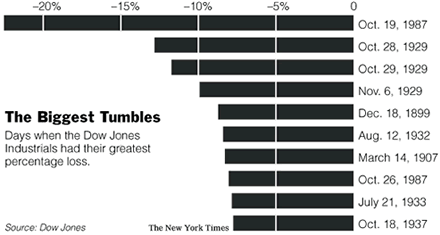
The Worst Days for the Dow

The New York Times points out that as painful as Tuesday’s 3.3% plunge in the DJIA was, “you could almost call that a blip when measured against the biggest plunges on record.”

dow_greatest_daily_percentage_loss

My gut tells me that we will get at least one more day this year that will surpass Tuesday’s drop.

Some Thoughts on Yesterday’s Stock Market Panic

Yesterday a 9% tumble in China’s stock market spread across the world causing the Dow to fall by 3.3% and many emerging markets to decline by even more. It is difficult to determine exactly what triggered the Chinese market sell off, but there were rumors circulating that the government will be introducing a capital gains tax.

Now its important to keep in mind that Chinese stocks have tripled since 2005. When stocks appreciate by so much in such a short time investors are looking hard to find an excuse to book profits. The rumor of a capital gains tax may have provided them with just that.

Whenever a large market such as China experiences some sort of chaos, it is reasonable to expect nervousness to spread around the world. China is an important US trading partner and US stocks fell in sympathy. Many emerging markets dropped because they are dependent on supplying China with commodities and raw materials.

The yen carry trade also played a role in causing the selling to spread beyond China. Yesterday, the yen appreciated by 2.3% amid the panic. This indicates that financial institutions that had borrowed yen to buy Chinese stocks, cut their losses by selling their stocks and buying back yen to close the trade. As the yen appreciated, others who were engaged in the carry trade were also forced to raise liquidity by selling their global stock holdings.

Yesterday, I watched CNBC for the first time in a while just to see if most of the talking heads had changed their rosy outlooks on stocks. Unfortunately, the consensus seems to be that the plunge was simply a correction and not the beginning of a bear market. As a contrarian, I feel comfortable believing that yesterday’s pain is just the tip of the iceberg.

Beware of Emerging Markets

Never before in history has the world experienced such synchronized growth. Improvements in communication and transportation, along with a reduction in duties and tariffs have made trade an important part of the global economy. When one country experiences rapid growth, its imports rise benefiting the economies of its trading partners.

Compounding this is that we are living in a fiat money world that is fueled by US debt growth. American consumers are buying goods on credit from around the world. Other nations are happy to sell their goods as long as they believe they will eventually be repaid. So both US consumption and foreign production are able to carry on at a brisk pace leading to a synchronized global expansion.

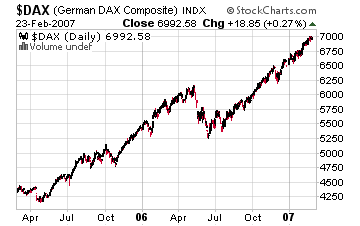
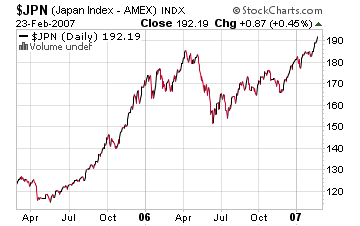
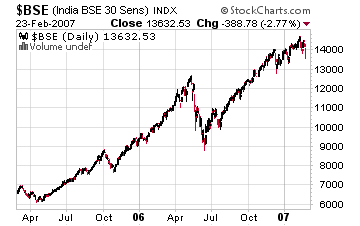
This interdependence can be seen in the similarity of the charts of stock markets around the world:

sp500german_dax_compositejapan_indexchina_indexindia_sensexbrazil_bovespa

What is clear from these graphs is that although the timing of the price gyrations are identical, emerging markets seem to experience greater gyrations. This should not be surprising. Emerging markets are comprised of companies that generate less revenue and operate at thinner margins than those of developed countries.

In the past few years, rising liquidity has benefited companies across the world. But Brazilian, Chinese and Indian stocks have been able to outperform American, German and Japanese stocks.

The reverse can also occur. When money becomes tight — like I believe will soon happen due to further weakness in US housing and an unwinding of the yen carry trade — stocks around the world will fall with the greatest declines being experienced by emerging markets. The period from May to June of last year offered a taste of this.

It may be difficult to realize under present conditions, but volatility can cut both ways. Unfortunately, many emerging markets investors will soon learn this the hard way.

The Subprime Market Implosion and its Consequences

The subprime mortgage market has been dominating news lately with signs that rising defaults and delinquencies are wreaking havoc on the mortgage industry. Here are some of the headlines:

  • Accredited Home Lenders Holding Co. reported a $37.8 million loss for the 4th quarter — three times wider than analysts expected.
  • ResMae Mortgage Corp. became at least the 20th subprime lender to close or be sold when it filed for bankruptcy.
  • Freemont General Corp., a major lender to people with weak credit histories, announced that it has stopped providing “piggyback” mortgages.
  • HSBC added $1.76 billion to its bad-loan costs for 2006 to cover ailing mortgages.

At the start of this year a general consensus has formed that housing is bottoming. This was based on 4th quarter statistics that suggested inventory, sales and starts were stabilizing. On Friday, Alan Greenspan gave an upbeat assessment on housing during a speech here in Toronto and made the following comments:

The worst of the adjustment is over, meaning not that the market is turning, but that the rate of decline was at its maximum in the third quarter and continued over in the fourth quarter and should now be moving to a much less negative direction.

Regarding sub-prime mortgages:

We do have a problem here, it’s probably not over. It may actually infect some parts of the prime mortgage market, but there’s no real evidence that this is a significant issue.

I have a different opinion than the ‘Maestro’. I believe that the subprime market implosion will lead to another leg down for housing activity. To see why, consider that a decade ago subprime mortgages totaled a mere 2% of the entire mortgage market. Today they are one-sixth of all mortgages.

subprime_mortgages

The percentage of subprime delinquencies are at the highest level since 2002. Keep in mind that the subprime mortgage market is now four times bigger than it was then. And the delinquency rate is likely to head much higher.

About 80% of subprime mortgages today are adjustable-rate mortgages that have been nicknamed “exploding ARMs” because they have low fixed-interest payments in their first few years but then usually adjust to higher interest payments. It is estimated that around $1 trillion in adjustable-rate mortgages are due to reset over the next 2 years at much higher interest rates.

A study by the Center for Responsible Lending predicts that 20% of subprime mortgages made over the last 2 years, equivalent to 5% of total mortgages originated could go into foreclosure. This new supply of foreclosed homes dumped on the market would easily push down prices and curtail home building.

Moreover, there is increasing pressure on Capitol Hill to enact legislation sponsored by Barney Frank, the new chairman of the House of Financial Services Committee, designed to tighten up lending standards and disclosure rules. This could shut out 25% of potential subprime buyers from obtaining mortgages according to Merrill Lynch.

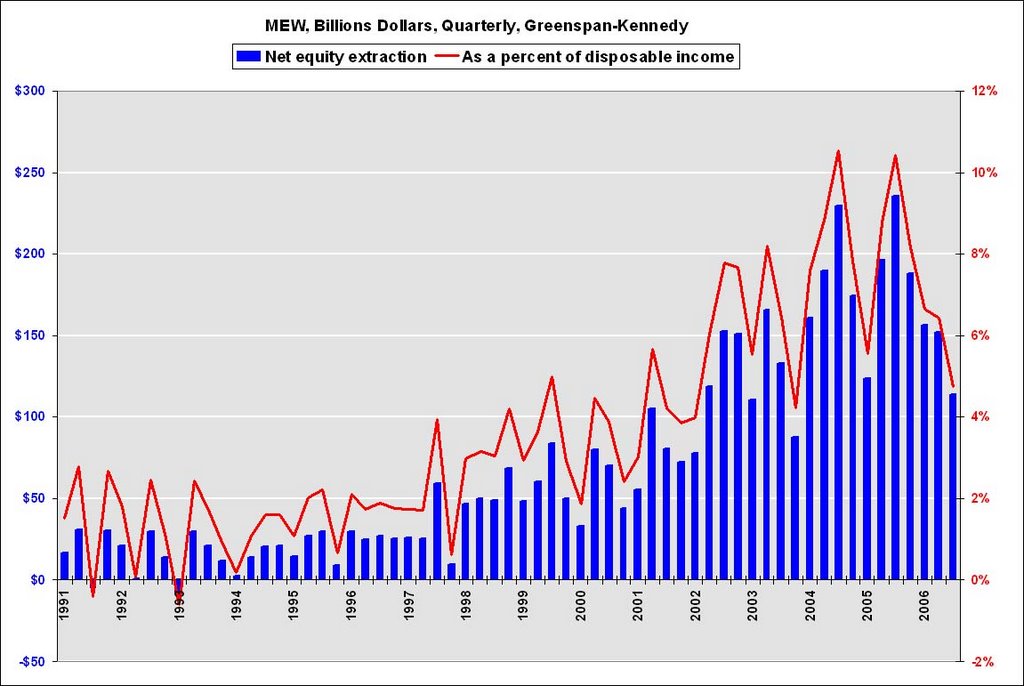
It is hard to imagine mortgage equity withdrawals (MEWs) continuing at the same pace as in recent years. Given that MEWs were a major source of household liquidity (as this graph by Calculated Risk depicts), consumer spending will have a tough time increasing.

Increasing foreclosures along with tighter lending standards for new borrowers is going to cause this housing downturn to be one of the worst ever, and likely to drag the economy into a recession.