On Thursday, I decided to up my bet against US retailers by shorting the Retail HOLDRS (AMEX:RTH) ETF at $99.11. The collapse of the housing market and the current credit crisis will soon cause the consumer to significantly cutback on spending. If retail stocks continue to rally, I am willing to further increase my short position.
Category Archives: Trades
Repositioning My Portfolio After the Sell Off
Thursday saw major declines in US stocks, which at one point had the S&P 500 down 10% from its 52-week high — a threshold defined as a market correction. This was the first correction in 52 months and the end of the second longest streak since World War II. However, Thursday afternoon the markets recovered and further recouped losses on Friday after the Fed announcement that the discount rate had been cut by 50 basis points.
The reduction in the Fed’s discount rate is simply a confidence restoration measure since it is still half a percent greater than the fed funds rate and discount window lending is only available to depository institutions, who are not the ones suffering from illiquidity. Nonetheless, the Fed is clearly shifting to an easing bias and will likely reduce the fed funds rate if there isn’t much improvement in the credit markets. So now that we got the long overdue 10% correction out of the way and with the Fed setting the stage for a cut to the funds rate, it would seem the markets have put its worst days behind it. However, I am not convinced.
First, significant downside risk remains to asset prices because although central banks have been providing funds at lower than market rates, there is no guarantee that this will immediately reduce recent investor risk averseness. It has barely been a month since the start of the sell off and it is reasonable to assume that most funds will hesitate to increase leverage until the almost daily flow of headlines of fund blowups wanes.
Second, the unwinding of the yen carry trade may not have ended yet. Last May and June the unwinding forced the yen to appreciate to as high as 110 yen per dollar or about 4% more from where the rate trades currently. The yen is probably around 30% undervalued compared to the US dollar based on long term monetary inflation rates and purchasing power parity. The yen can easily rise to 100 per dollar over the next few quarters as the rest of the world lowers interest rates to stimulate growth and brings them closer to Japan’s. Such a rapid appreciation will diminish the attractiveness of the carry trade and put downward pressure on asset prices.
Third, the US consumer is tapped out and will reduce spending in the coming quarters. The trade deficit has been the biggest source of global liquidity because the dollars earned by foreigners are mostly invested in US assets which stimulates credit expansion in both the US and the exporter’s country. Assuming energy prices don’t rise, the trade deficit should improve. Moreover, an environment of declining consumer spending will hurt corporate profits and make equity valuations look expensive.
An early August Merrill Lynch survey of global fund managers showed that just 7% believed that a global recession is likely in the next 12 months, with most regarding the current turmoil as a buying opportunity. Not surprisingly, Street economists expect tightening credit to hurt consumer spending — but they’re still penciling in economic growth near 2%. Until economists and analysts cut their forecasts for economic and corporate profit growth to around zero, I can’t get bullish on stocks.
The US economy is highly leveraged and an extended period of deflation would be catastrophic. To prevent this, the Fed will surely inflate the money supply to the extent that is needed to counteract credit contraction. That will lead to a weaker US dollar, soaring consumer prices, disappointing equity and fixed income returns (in real terms), and a much higher gold price.
That said, although base metals prices declined along with other assets, they are still grossly overvalued, and I find it hard to be an aggressive buyer of gold as long as this remains the case. Many funds which speculated by buying gold along with copper, nickel, zinc, etc. may decide to sell gold along with the other metals to raise cash if any of the risks I outlined are realized. I did add to some of my gold positions during Thursday’s steep sell off, but I wouldn’t describe my buying as substantial.
I covered most of my short positions in base metals stocks and U.S. Steel (NYSE:X) on Wednesday and Thursday. I was up 25-35% on most of the shorts and they served their purpose of hedging my junior gold stocks which were hit hard. If base metal stocks rally from here, I will go short again. My remaining short positions are mostly in retailers. I am also keeping 30% of my portfolio in cash in case my favorite stocks get cheaper.
Shorting Retailers
I am currently holding a significant short position in retail stocks because I believe consumer spending is beginning to falter. The housing recession, which began with the collapse of homebuilding stocks, has started to spill over to rest of the economy as can be seen in the recent troubles of financial stocks. The next shoe to drop maybe the shares of retailers.
My favorite shorts are Black & Decker (NYSE:BDK) which depends on a strong housing market; Dick’s Sporting Goods (NYSE:DKS) which depends on healthy discretionary spending; and Target (NYSE:TGT) which has so many stores that they will not be able to grow profits in the face of a general slowdown in consumer spending.
Closing My Short Position on the Brokers
In August of last year, I mentioned my initiation of short positions on Bear Stearns (NYSE:BSC) and Lehman Brothers (NYSE:LEH), two investment banks which had profited handsomely from the abundance of liquidity in the financial system.
Both stocks continued to perform well for the next few months, at which time I decided to double down on my short position. It was not until February that the problems I were looking for in the brokers began to catch the attention of the market. I have now decided to close my short position in both stocks with around a 20% gain.
Protecting My Portfolio From a Crash
I believe the recent global equity sell-off may have marked the beginning of a period of much greater volatility. If so, the possibility of some sort of violent financial crash cannot be ignored. The world has been flush with liquidity originating from the US trade deficit and the yen carry trade; this has encouraged extreme speculation in asset markets.
The present environment of indifference to risk rarely reverses in an orderly manner. Seemingly mild negative news could set off a positive feedback loop that drives investors to sell.
Here are some possible events which elicited little fear from investors in the recent past, but in the present environment could spook investors enough that they regain their appreciation for cautiousness:
- the introduction of capital or currency restrictions by some government in a major emerging market
- a financial accident in the subprime lending or derivatives market
- a major corporation declaring bankruptcy
- a large multi-billion dollar hedge fund blowing up
- a natural disaster
- the outbreak of a deadly disease
- an escalation of geopolitical tensions or a terrorist attack
My intention is not to scare people, but to warn investors of a higher than normal probability of significant near-term financial loss. I have prepared my portfolio by selling some of my gold stocks and shorting brokers, commodity producers and emerging markets. However, I wouldn’t recommend this strategy to others. The easiest way most people can protect their portfolios is by selling some of their assets and keeping cash and physical gold.
Buying the Yen ETF
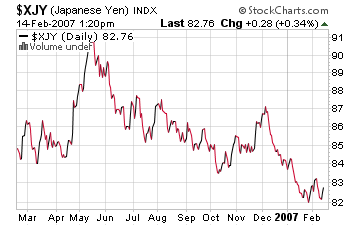
In my previous post I mentioned that I was sitting on 20% cash. Today I decided to use almost all of that cash to buy the CurrencyShares Japanese Yen Trust (NYSE:FXY) for $82.75 per share. In effect, I am still in cash — albeit yen rather that dollars.
My motivation for this trade is that I believe the yen carry trade will soon end, which will cause the yen to appreciate against most currencies. Last year, the yen was one of the worst performing currencies in the world. This year it could be the best.
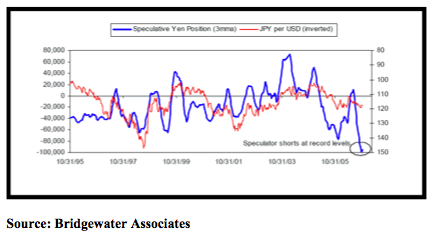
As a contrarian, I am also delighted to see that there is a record speculative short position in the yen.
It should be noted that, unlike the other CurrencyShares, the Japanese Yen Trust currently doesn’t pay any dividends because Japanese interest rates are barely able to cover the trust’s expense ratio. But I believe a rise in the yen will more than make up for this shortcoming.
Doubling Down Against the Brokers
Fueled by stronger than expected earnings and a rising stock market the brokers have rallied by 15-20% since I mentioned that I was going to short them. However, my long-term view of the sector is unchanged. The economy will suffer a housing-led recession in 2007 that will hurt the brokers’ profits significantly. The current rise in their share prices could mean a greater fall once the stock market begins to decline.
Therefore, I am really attracted to the potential payoffs of shorting the brokers at current prices. I am currently short Lehman Brothers (NYSE:LEH) and Bear Stearns (NYSE:BSC). I will be doubling my short position in these stocks.
Shorting the Brokers
Earlier this month Marc Faber caught my attention for predicting that the stocks of brokers are set-up for a fall similar to the stocks of the home builders 12 months ago. An article in yesterday’s Barron’s discusses this idea in greater detail;
NOW MIGHT BE A GOOD TIME TO RING UP THAT BROKER who put you into Ford shares two years ago and let him know his best days are probably behind him.
Following a remarkable four-year run that’s more than doubled the value of some Wall Street brokerage stocks, analysts have begun to pare earnings numbers amid worries that slower economic growth and higher rates have substantially increased the risks for this high-flying cyclical group that includes Bear Stearns (ticker: BSC), Goldman Sachs (GS), Lehman Brothers (LEH), Morgan Stanley (MS), Merrill Lynch (MER) as well as global financial conglomerates like Citigroup (C) and JPMorgan Chase (JPM).
The brokers are victims of their own success. Results have been great in all of their most important business lines, including equities, mergers and acquisitions, asset management and private equity. The firms’ prime brokerage services, which mainly serve hedge funds, have thrived, and improved markets have spurred record proprietary trading gains. Even fixed-income profits in areas like mortgage securities have held up despite the Federal Reserve’s interest-rate hikes.
“There’s nothing that can get better. Every cylinder has been firing away,” contends Charles Peabody, an analyst at Portales Partners, a New York financial-services research boutique.
Peabody is among those who believe a more hostile environment won’t allow the brokers to jump from success to success much longer. The Fed’s tighter monetary policy has drained liquidity from U.S. markets and central banks around the world have started to follow the same path. As funding gets more expensive, investors’ appetite for risk will decline, making it tougher to underwrite profitable equity and debt offerings or to continue Wall Street’s incredible streak of trading gains.
No doubt rallying stock and bond markets would continue to bolster brokers’ shares, but the odds against that occurring seem to be growing. The bottom line, says Peabody, who rates the brokers a Sell: “I think you could have earnings drop 30% next year.” That presumably would take a commensurate chunk out of the stocks.
Brian Rauscher, director of portfolio strategy at Brown Brothers Harriman, also has a Sell recommendation on the group because he believes their relative-earnings-estimate revisions have peaked. In other words, the group’s earnings aren’t going up as quickly as they had in the past. And, before this cycle ends, Rauscher believes, earnings estimates will start to get cut.
A quick reversal of fortune is possible if private-equity gains slow or margins in the prime brokerage business get skinnier because of increasing competition. A housing-industry slowdown could dramatically reduce the production of new mortgages, leaving some firms with bloated overheads. And if the recent stock-market rally turns out to be a bear-market bounce, the summer doldrums that have depressed equity underwriting volumes could extend into the fall.
The dollar value of initial public offerings in the U.S. for this summer is down 49% this year and the number of IPOs is down by 52%. Similarly, the value of IPOs worldwide is off 9% and the number is down 25%, says Thomson Financial. The decline not only hits underwriting profits but also makes it more difficult for private-equity shops — including those within Wall Street firms — to exit their investments via IPOs.
The flood of money into private equity (see Eliminate the Middleman) may ultimately shrink returns in one of Wall Street’s most profitable areas. Private-equity investments have boasted returns of 20% or more for the past three years, so everyone and his uncle has raised a fund. Total fund-raising doubled from 2004 to 2005, when it exceeded $100 billion, reports Brad Hintz, an analyst at Sanford C. Bernstein. As venture capitalists of the late 1990s can attest, excellent returns attract huge waves of capital, which in turn can kill the returns for those who are late to the party.
Goldman Sachs has the largest private-equity division on Wall Street, having raised an $8.5 billion fund last year. The company reported $354 million of gains and overrides from corporate and real- estate-principal transactions in the second quarter alone. The problem with these returns, as well as those from proprietary trading, is that they’re usually nonrecurring. So a firm must run faster each quarter to top its previous returns.
Investment banks don’t typically divulge their proprietary trading gains or losses, though most acknowledge the profits have been substantial. The success has also persuaded the firms to take on more risk with their own capital. At Goldman the average daily value-at-risk, or VaR, was $112 million last quarter, almost twice the $60 million reported a year before. VaR estimates the potential loss in value of a firm’s trading positions on a bad day.
“Everyone is extrapolating the strength of proprietary desks into the future, and I think that’s a mistake,” says Doug Kass, head of hedge fund Seabreeze Partners.
Uncertainty is evident in the wide spread of analyst opinion about Goldman’s earnings per share next year: $14.48 to $21.05. It’s also why multiples in the sector, which range between nine and 11 times ‘07 estimates, might not be as low as they first appear. If, say, 30% of earnings disappear overnight, multiples jump pretty fast.
A Goldman spokesman counters that history is on the firm’s side. “Over the course of a business cycle, our geographic, business and product diversity can be expected to deliver earnings growth, as they have in 18 out of the past 21 years,” he says.
A housing slowdown may also hurt brokerages that have built up massive businesses around residential mortgages. Last year $460 billion of home-equity asset-backed securities were sold, up from $74 billion in 2000, and $991 billion of mortgage-backed securities were issued, up from $185 billion five years prior, according to Thomson Financial.
Lehman dominates this market. In 2003 it acquired Aurora Loan Services, a residential loan originator, and it has since made additional acquisitions. Now it can originate loans, service them, securitize and sell the bonds backed by the mortgages and then trade the securities.
In the first half of 2006 Lehman originated about $31 billion of residential mortgage loans. It also purchased loans in the open market and pooled them to securitize $67 billion of residential mortgages in the first six months of the year. But not everything is securitized every night. At the end of the second quarter, Lehman had $4.2 billion of loan inventory on its books.
The firm also held about $800 million of non-investment-grade interests in securitizations at the end of the quarter. Underwriters often retain the most junior, risky pieces of a securitization if investors won’t. The value of these volatile residual securities typically are hit first if more mortgage holders than expected default or prepay their mortgages. It’s unclear how much of Lehman’s inventory is hedged for interest-rate or credit risk, and the firm declined to comment. In any event, Lehman seems to have a vested interest in the continuation of the housing boom.
While Lehman and Bear Stearns have the most active mortgage operations, juicy profits have lured others into the game. Most recently Morgan Stanley purchased Saxon Capital, which originates and services subprime residential mortgages, for $706 million.
If the residential mortgage market declines — as the 25% year-over-year drop in mortgage applications suggests — brokers might soon find they have lots of folks looking for something to do. The firms hope their origination arms will gain market share to keep the flow of mortgage loans going. They’re also eyeing the reset of adjustable-rate mortgages in the next few years and the global expansion of the mortgage business as new sources of business.
The prime-brokerage business also runs the risk of disappointing investors. Morgan, Goldman and Bear Stearns control almost two-thirds of this business, estimates Hintz of Bernstein. The shops cater to hedge funds and lend out stock to cover short positions, provide cash-management services, lend on margin, clear trades and provide reporting and custody services.
Hedge-fund clients tend to execute about 20% of their trades on their prime broker’s equity desk. Hintz estimates the hyperactive funds now generate 30% to 35% of the U.S. securities industry’s equity commissions. Their high portfolio turnover and interest in exotic — read: higher-margin — securities makes them hugely attractive Wall Street clients.
Here, too, competition has arrived and profits will be tougher to come by. Merrill, Lehman, UBS and Deutsche Bank are among those who have jumped in. Hedge funds increasingly split their prime business among two or three players instead of staying with just one shop.
And the business may be getting riskier as new entrants offer easier borrowing terms, says Hintz. Firms are more inclined today to lend the same amount against a security or a portfolio for 30 or 60 days, whereas in the past the loan varied daily with changes in the security’s price. Such a change exposes the broker to more risk should the value of the security drop sharply. Newer entrants are also extending loans against entire portfolios instead of against specific securities.
“They’re becoming liquidity guarantors to the hedge funds,” says Hintz, who has Market Perform ratings on Goldman, Morgan, Bear and Lehman, and Outperform ratings on Merrill and JPMorgan Chase.
Morgan Stanley’s prime brokerage unit, says a spokesman, expects “demand for these types of services will increase, not decrease, as modern asset managers trade in an increasing number of different asset classes and markets.”
Hintz estimates that Morgan and Goldman’s prime-brokerage pretax net income will rise about 12% annually over the next few years, down from the 20% gains enjoyed in past years. Bear Stearns, which has the most exposure to domestic business, is the most vulnerable of the three and may find it can increase the group’s bottom line by only 3% in that time.
Growth like that might not satisfy investors who’ve come to expect much more from their brokers.
I plan on taking a short position on the brokers this week. My favorite short candidates are Lehman Brothers (NYSE:LEH) and Bear Stearns (NYSE:BSC).


