Author Archives: Administrator

Closing My Position in Fed Funds Futures

I just closed my long position in the federal funds futures contract for February 2009 at 98.24. The contract is spiking higher tonight as it looks increasingly likely that a bankruptcy filing is forthcoming from Lehman Brothers. My average cost was 97.17 and in just 11 weeks I have realized a profit of around $4500 per contract compared with an initial margin requirement of $1350 per contract.

The market is starting to realize that the banking system is facing a meltdown with interest rate spreads sharply widening. As such, the Fed cannot increase its key lending rate. And with the recent collapse in commodity prices and a stronger dollar, further rate cuts look quite likely. I believe the Fed will cut rates, but I don’t know if it will cut rates by more than 25 basis points over the next few months. Therefore, I decided to take profits in my fed funds futures contract and look for other opportunities.

Shorting SunTrust Banks (NYSE: STI)

Over the last few weeks I have been taking advantage of the rally in financial stocks to accumulate a short position in SunTrust Banks. My average price is $42.93, but I do plan to short more shares if the price continues to rise. As I have explained previously, US banks are facing a massive credit bust that will lead to hundreds of institutions becoming insolvent. To profit from the situation I am shorting some of the banks which I think have a high probability of failing. Washington Mutual is one. SunTrust is another.

SunTrust’s core market is the US Southeast, namely Florida and Georgia. Florida is right up there with California as having the worst housing markets in the country. I believe SunTrust’s exposure to Florida real estate along with its thin capital cushion will cause it to struggle to survive. In particular, the bank has a huge portfolio of construction & development loans amounting to 115% of its tangible equity.

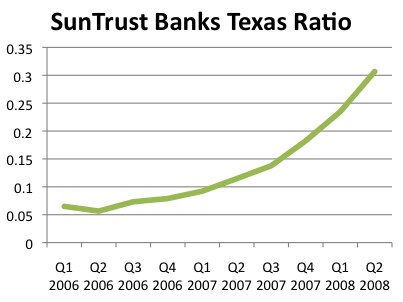
Already SunTrust’s loan portfolio is showing a disturbing trend. Below is a chart of SunTrust’s Texas Ratio, which is calculated by dividing non-performing assets including loans more than 90 days delinquent by the bank’s tangible equity plus loan loss reserves.

SunTrust Texas Ratio

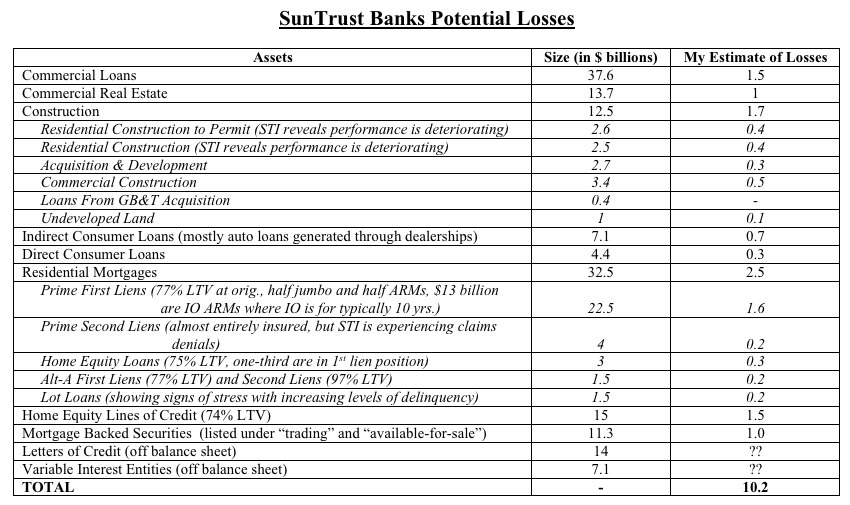
The following is my estimate of the writedowns that SunTrust will have to take over the next two years. The economic environment that I have assumed is one in which the US will fall into a prolonged recession marked by unusually high numbers of personal and corporate bankruptcies.

SunTrust Banks Losses

If SunTrust were to lose $10 billion, it would be left with little tangible equity. But before its tangible equity gets to close to zero, regulators would force it to raise capital. Since this would be very dilutive to existing shareholders, the stock would sell off sharply making any possible offering so dilutive that it would be nearly impossible. This would be a similar situation to what Freddie Mac faced and what Lehman Brothers and Washington Mutual currently faces. If SunTrust is unable to raise capital then at some point depositors will get nervous and pull their funds, thereby creating a liquidity problem for SunTrust and forcing it to be taken over by the FDIC.

To summarize, I think betting against banks is a good speculation in the current climate and SunTrust is, in my opinion, one of the weaker institutions.

Selling MBIA Calls

One year ago, I initiated a short position in MBIA (NYSE:MBI) based on a compelling presentation by hedge fund manager Bill Ackman. I shorted the stock at $61.29 and closed the position two months later at $46.47. My reasoning for ending the trade at the time was that MBIA had not disclosed in detail its CDO and RMBS exposures so in my mind there existed a possibility for MBIA to absorb the losses and survive. Unfortunately, shortly after closing out my position MBIA did provide more color on its insured structured finance portfolio and it wasn’t pretty. Before I could short the stock again, its price plummeted.

In April, I finally decided to pull the trigger and reopen my MBIA short position. Unfortunately, my broker was having difficulty locating stock to short. So I thought I would take advantage of the volatility of the stock price to sell MBIA January ‘09 calls with a strike price of $10 for $4 each. Until a few weeks ago I was sitting on a wonderful gain on this position as the options looked likely to expire worthless. However, recently MBIA’s share price has staged a miraculous recovery tripling to its current price of around $16 giving it a market cap of $4.4 billion for the first time since last November when its share price was $35 (MBIA has more than doubled its share count this year via secondary offerings).

Part of this rally is probably due to short covering as MBIA is one of the most heavily shorted stocks on the NYSE. But the ignition for the fire was provided by MBIA’s 2nd quarter earnings release as well as news that the company has reinsured a large public finance portfolio from FGIC. None of these events change my expectation that MBIA is going to face staggering losses in its structured finance portfolio that could render it insolvent. So last week I took advantage of the strength in the stock and sold some more January ‘09 calls, this time with a strike price of $15 for $3.30.

One’s opinion on whether MBIA is a buy or a sell largely depends on his macroeconomic outlook. If the current credit crisis begins to subside by early next year and the downturn in the economy is mild with a decent recovery similar to 2001, then defaults leading to claims in MBIA’s insured portfolio will not rise much from current levels and the company will return to positive operating cash flow by 2010. On the other hand, it is my belief that we are in the midst of the worst financial crisis since the Great Depression and a recession that will last beyond 2009. Personal and corporate bankruptcies will surge to levels not seen in decades and MBIA will be inundated with claims.

To conservatively estimate MBIA’s losses, I have assumed an outlook that is between the two that I have described above. Below are my estimates along with Bill Ackman’s from his Open Source Model.
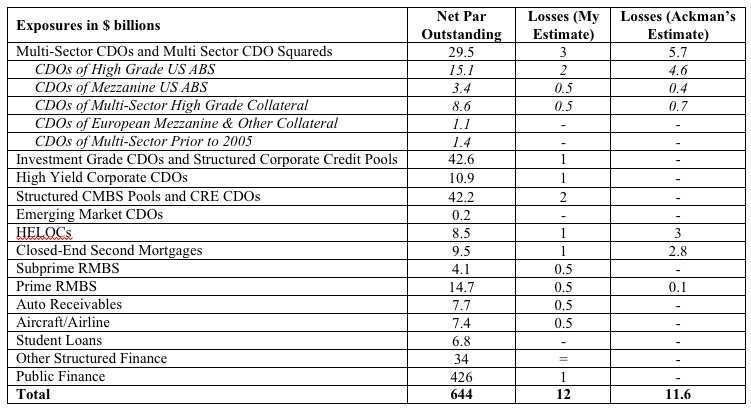
MBIA Projected Losses

We both calculated a $12 billion loss. While he is projecting greater losses arising from MBIA’s multi-sector CDOs and second lien mortgages exposures, I am including additional losses in corporate CDOs, CMBS, auto receivables, student loans and public finance.

This is because I believe the current problems in the mortgage market are symptoms of a greater problem: a general mispricing of risk. Ultra-expansionary monetary policies conducted by the Federal Reserve in years past encouraged lenders to lend capital at terms and interest rates that didn’t adequately compensate them for the risk they were taking. This was prevalent in commercial real estate, corporate borrowing, consumer credit, municipal bonds, as well as the housing market. Now that the economy is likely in a recession, defaults will rise across the board.

Another risk MBIA faces is that it has reinsured $41.7 billion of its portfolio with Channel Re, a company which MBIA owns a minority stake in and counts MBIA as its only customer. Approximately half of the reinsured portfolio is comprised of CDOs meaning that ChannelRe is at a high risk of collapsing. If so, the reinsured policies would come back onto MBIA’s books. Using my estimate of approximately 6% loss on MBIA’s CDO exposure to calculate Channel Re’s loss on its $20 billion of CDO exposure results in a further loss to MBIA of $1 billion. Therefore, in total I expect $13 billion in losses.

If MBIA’s insurance subsidiary (MBIA Corp.) were to suffer $13 billion in losses, I don’t think it will be able to survive. MBIA would surely disagree and state that it has $16 billion in claim paying resources. The problem is that the losses will almost entirely come from structured finance credits which are of much shorter duration compared to public obligations. This means that MBIA would be swamped by claims over the next few years. As its capital base dwindles, its claims paying ratio would skyrocket resulting in further downgrades from the rating agencies. Basically, I don’t think the holding company and MBIA shareholders will receive another dividend from the insurance subsidiary.

The recent loss of MBIA’s triple-A status has resulted in an inability to write any new public finance policy of significance and the company has decided to withdraw from the structured finance business. Now its sole sources of cash flow are interest income and structured finance premiums on policies written in the past. (Premiums from public finance policies were paid upfront). Adding salt to the wound, the company’s 2nd lien mortgage exposures have resulted in a rising number of claims and a 2nd quarter that generated zero cash flow. If there are additional claims in the 3rd quarter MBIA will start burning cash. As the following chart suggests, 2nd lien RMBS claims have been surging over the past 3 quarters.
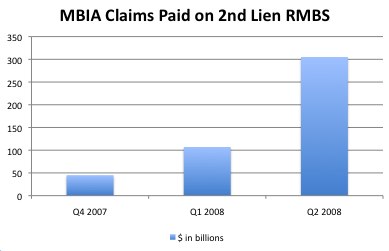
MBIA Claims Paid

Surprisingly, MBIA is not expecting a significant further rise in claims as it has reserved only $796 million in RMBS losses (2% of RMBS gross net par) and $243 million in other losses. In addition, the company has only booked $1,040 million in impairments related to its CDO exposure (0.8% of its CDO gross net par). This is significantly lower than what the market thinks based on market prices or what investment banks have already accepted as losses. Is it possible that MBIA was more stringent in what it insured resulting in a portfolio of better quality? Not according to Ackman:

From 2005-2007, the total universe of ABS CDOs outstanding is comprised of approximately 534 deals. While MBIA and Ambac appear to have only limited direct exposure to this pool (having directly guaranteed only 25 and 28 CDOs, respectively), in fact, MBIA and Ambac are actually exposed to at least 420 and 389, respectively, of the 534 total CDOs outstanding if you include the CDO exposures within the CDOs they have guaranteed. The fact that MBIA and Ambac have direct or indirect exposure to 79% and 73%, respectively, of all ABS CDOs issued from 2005-2007 directly contradicts the insurers’ public statements about their “highly selective” approach to CDO guarantees.

The same can be said about MBIA’s RMBS exposure. So I don’t think the company has adequately reserved for future losses and once it does it will wipe out its capital base leading to additional downgrades.

A downgrade below AA would be problematic as it would require MBIA’s asset management subsidiary to terminate certain GICs issued to municipalities and post additional collateral on others. For example, a downgrade to triple-B would cause a maximum potential termination of $9.2 billion. This would force MBIA to liquidate at a loss most of its investment portfolio which includes instruments such CDOs and RMBS. The asset management subsidiary already has negative equity, so such a series of events would make it insolvent.

The only ray of hope for MBIA shareholders is if the holding company is successful in starting a new monoline insurance subsidiary with a triple-A rating. But I wouldn’t assign much value to this since the holding company’s balance sheet would have no equity if the investment in MBIA Corp. is excluded. So without much capital to infuse into a new insurance subsidiary, MBIA wouldn’t be able to write many policies. And considering the entry of Berkshire Hathaway as a competitor, the collapse of the structured finance market and the loss of interest in guaranteeing public credits I don’t think MBIA can make much money.

In conclusion, I think shorting MBIA or selling calls on it at today’s prices is an excellent speculative bet.
The US Banking System Faces Collapse

Over the last 6 weeks financial stocks have rallied prompting some market commentators to declare that most of the losses banks will suffer during this downturn have already been written off. I strongly disagree believing that we are still in the early innings of this credit crisis and things are likely to get much worse before they get better. Let me explain.

As I argued here and here, home prices are likely to fall by 30% resulting in approximately 20 million homeowners with negative equity in their homes of which 5 million could face foreclosure. If the average mortgage balance of foreclosed homes is $250,000 and half of the balance is recouped after foreclosure then the total loss for lenders would amount to more than $600 billion.

Since the total mortgage market for single family homes is currently valued at over $10 trillion, this represents a loss of 6%. Some lenders will face greater defaults than others. The GSE’s which guaranteed approximately half of the total mortgages outstanding will probably experience only a 2-3% loss (though that would be disastrous for them considering their thin capital cushion). Commercial banks and savings and loan institutions may experience 8-9% losses; investment banks and hedge funds which speculated on subprime mortgages and CDOs may suffer losses of well over 10%.

According to the FDIC, depositary institutions had $3 trillion of residential real estate loans on their books at the end of 2007. A 8% haircut on this would lead to a loss of around $250 billion. Though mortgage lending is getting all the attention now, it’s important to understand that lending standards were lowered for all types of loans and banks are likely to suffer significant losses in other areas of their loan portfolios as well.

My estimate of these other losses for depositary institutions include at least 7% of their $1 trillion of consumer loans, 10% of their $630 billion of construction and land development loans, 5% of their $970 billion of commercial real estate loans, and 5% of their $1.5 trillion of commercial and industrial loans. In total banks are likely to write down their loan portfolios by at least $500 billion. The problem is that the entire equity capital of banks amounts to $1.35 trillion of which $350 billion is goodwill. This means that half of the tangible equity of US depositary institutions would get wiped out leading to hundreds of bank failures.

But also consider that these banks have entered into $166 trillion of derivatives contracts with one another meaning that if a significant number of banks fail due to loan losses, their counterparties on derivative transactions would be unable to collect payment and could also be dragged down into insolvency and the entire banking system would collapse.

And I have not factored in losses at other financial institutions such as GSEs, investment banks, insurance companies, and hedge funds. In total I think we are looking at losses of at least $1 trillion at US financial institutions and $2 trillion globally over the next few years. Keep in mind that only $500 billion have been written of thus far, and that is why I believe that we are still early in this credit crisis.

This makes me very concerned. It’s quite possible that my estimates could be wrong, but I think I have been conservative enough that any substantial error in loss estimates will understate the actual values. Do I believe the entire banking system is about to collapse? No… at least not anytime soon. We live in a fiat monetary system which means that the government can print as much money as it wants to bail out the creditors of failed banks. To be sure, governments will soon run the printing presses at full speed in an attempt to restore the public’s confidence.

A Tsunami of Foreclosures Lies Ahead

Because this housing downturn ranks, by several measures, as the worst since the Great Depression, it’s quite likely we will see an unusually high number of foreclosures. It’s important to understand the magnitude of the defaults because that would provide color on the mortgage losses that banks will face.

I concede that it’s extremely difficult to estimate the number of future foreclosures, however I believe that by employing some thorough analysis one can at least come up with a ballpark figure that could be useful.

In my previous post I concluded that homes prices are likely to fall by around 30% from peak to trough which will be reached by early 2010 if not sooner. According to the following graph, that kind of price depreciation will lead to 20 million homeowners being underwater on their mortgages; that is, their mortgage balances will exceed the value of their homes.

Homeowners With No EquityGraphic by Calculated Risk, Data by First American

Since most mortgages are non-recourse, homeowners with negative equity have an enormous incentive to simply mail their keys to their lenders and abandon their homes. Of course, the majority of homeowners won’t do this for at least three reasons: first, they may believe their homes are worth more than what the statistics say; second they would not want to damage their credit rating which would hamper future borrowing; and third, they would want to avoid the social stigma of foreclosure.

That said those people who speculated in residential properties are likely to mail in their keys and accept an investment loss. Also, those people who suddenly need to move will realize that they can’t quickly sell their homes for a high enough price to pay off their mortgage balance and will instead simply default.

However, in most cases negative equity will only lead people to foreclosure when they are facing financial difficulties at the same time and are having trouble servicing their debt. Refinancing or selling their houses, options which in the past saved delinquent homeowners, are now off the table.

A major ticking time bomb is rate resetting mortgages which are widespread and, as the following graph shows, hundreds of billions of dollars worth of them are about to reset to much higher rates.

Monthly Mortgage Rate Resets

As a side note, this graph fails to convey that the majority of the option adjustable mortgages will begin to recast next year rather than 2011 as depicted because most borrowers have been paying only the minimum required resulting in negative amortization which has caused their mortgage balances to reach their principal caps much sooner.

Many of these homeowners will come to the realization that it doesn’t make sense for one to give up most of his income to service a mortgage with an 8% interest rate on a house that is worth less than the amount of the loan.

I believe it’s safe to assume that one-fifth of all homeowners with negative equity could ultimately default on their mortgages. So if home prices fall by 30%, 20 million homeowners will have negative equity and 4 million mortgage borrowers could default.

Plus another one million homeowners with positive equity could also face foreclosure due to an inability to maintain mortgage payments arising from resetting interest rates or loss of jobs (after all, we’re in an economic downturn with rising unemployment) with no option to refinance.

Thus, we are facing 5 million foreclosures or 10% of all owner occupied homes with some mortgage. Already the delinquency rate is spiking as the following graph shows:

Delinquency Rates For Single-Family Residential MortgagesSource: Federal Reserve

If lenders try salvage part of their investment by foreclosing on millions of homes and dumping them onto the market, the supply of existing homes for sale would surge from its current level of 4.5 million which is equivalent to 11 months of supply at the current sales pace. This would prevent a housing recovering from taking form for many years.

Now it is quite likely that major government intervention could significantly reduce the number of foreclosures — but the losses will then have to be absorbed by taxpayers as well as by lenders. In any case, the US economy will suffer.

Buying Fed Funds Futures

Today I purchased the 30 day federal funds futures contract for February trading on the Chicago Board of Trade for 97.17 meaning that I do not believe that the Federal Reserve will increase the fed funds rate above 2.83% by February. The market has priced in a hike of at least 83 basis points within the next 8 months due to Bernanke’s and other committee members’ recent speeches expressing concern for the weakening dollar and rising inflation. The fear is that the Fed will follow up its hawkish talk with aggressive monetary tightening.

I think the market, which gives the Fed far more credibility than it deserves, has been hoodwinked by Bernanke and co. in the Fed’s attempt to manage inflation expectations. It is actually quite clear that the Fed will not significantly tighten anytime in the near future if we consider two facts.

First, the Fed is a private entity owned by all of the chartered banks of the US. Although congressional oversight and statute can alter the Fed’s responsibilities and control, currrently it does have the authority to act independently without prior approval from the President or Congress. Thus, while the government’s hope is that the Fed will act to promote economic growth, a sound currency, and a stable banking system — its greatest incentive is to act in the interests of its shareholders (i.e. banks).

Second, the balance sheets of banks are rapidly deteriorating as what was once thought to be an exclusively subprime problem, is now beginning to be recognized as a widespread underpricing of risk that has also affected prime real estate mortgages, commercial real estate mortgages, consumer loans, corporate credit, municipal bonds, and derivatives. US banks alone have written off a couple of hundred billions of dollars worth of subprime mortgages and writedowns related to other assets are only beginning. With only $1.2 trillion of capital within the entire US banking system, a huge flood of bank failures is looking increasingly likely.

If these two facts are put together — a Fed that acts primarily in the interest of banks and a continued deterioration in bank balance sheets — then the Fed will continue to promote an easy monetary policy. Indeed, a low Fed funds rate will promote a steep yield curve which should provide some relief to banks who are in the business of borrowing short and lending long.

That said, if oil prices begin to rise parabolically and/or the US dollar depreciates rapidly, it would not surprise me to see the Fed hike by 25 basis points to persuade the markets that it is about to embark on a tightening mission. However, the 83 basis points increase in the Fed funds rate that the futures market is pricing in by February, in my view, has a very small chance of becoming reality.

Doubling Down on Altius Minerals (TSX:ALS)

I decided to double my investment in Altius Minerals (TSX: ALS, Pink Sheets: ATUSF) after the company’s stock price plummeted by more than 40%. I originally analysed the company here. The reason for the collapse was that Altius was notified by Newfoundland and Labrador Refining Corporation (NLRC) that it was seeking creditor protection after SNC-Lavalin, an engineering firm which provided services for NLRC, served NRLC with a notice of proceedings that it was seeking to have NLRC declared bankrupt.

Altius Minerals is the largest holding in my portfolio because I was very optimistic that its investment in NLRC could be worth several billion dollars in a few years. Indeed if the refinery was up and running today it would be enjoying gross margins well above the $26 I used to value the company last December. And no other refinery project in North America has succeeded in obtaining all the environmental permits as NLRC has.

My take on the dispute between SNC-Lavalin and NLRC is that SNC-Lavalin has not been paid for its services and is trying to leverage that into an equity stake. I could be wrong, but I cannot see how SNC-Lavalin will gain by seeing NLRC bankrupt. Even if SNC-Lavalin were awarded all of the assets of NLRC, which would not be worth the $20 million they are owed or millions more they stand to make in future services, it would be difficult for it to go ahead and complete the refinery without the support of Altius’ management who are Newfoundlanders with immense support from the provincial government and the local community.

I would be surprised if SNC-Lavalin and NLRC do not come to an out of court settlement within the next few months. Altius and the other investors of NLRC may need to concede equity to SNC-Lavalin to resolve the issue, but it would be best for all parties involved to not see NLRC bankrupt.

But even if we assume that the refinery project is dead then Altius’ loss should be limited to the $52 million invested in NLRC. Altius still has around $8 of net asset value per share and at Friday’s closing price of around $7, this would constitute an attractive value investment. Management has a track record of steadily growing net asset value over the long run and with Altius’ large holdings of resource rich land in Newfoundland, I have no doubt that shareholder value will be created over time. I bought a lot more stock on Friday at an average price of $7.10.

Interview With Mohamed El-Erian

There was an interview in Barron’s over the weekend with PIMCO’s Mohamed El-Erian in which he prescribes to investors how to approach the troubled financials. Here is an excerpt:

Barron’s: What kind of noise do you hear now, and what is it telling you?

El-Erian: “We’re seeing two different realignments. The first is the return of inflation, with the rise of the world vis-à-vis the U.S., and an amazing rally in commodity prices. It’s amazing how quickly the rally occurred. These are reactions to fundamental changes.”

“We will also see new reactions to crisis management steps. This part isn’t in the book because I didn’t foresee the March 16 action by the Federal Reserve. [On March 16, the Fed helped arrange a sale of Bear Stearns to JPMorgan Chase, providing as much as $30 billion in financing for Bear’s less-liquid assets such as mortgage securities. In addition, the Fed allowed securities dealers to borrow from the central bank under terms normally reserved for regulated banks.] Opening up the financing window for investment banks is going to realign the financial system as we know it.”

How so?

“First, it will be very difficult for the Fed to withdraw the window once it’s introduced. What’s temporary will become permanent.”

“Second, once the window is permanent, these institutions will be subject to greater regulations aimed at de-risking. If you’re a senior bondholder, you’ll do well, and if you are an equity holder, you’ll be diluted, because A) the institution is going to be issuing more capital and B) the return on equity is going to come down. That action has very different implications depending on where you are in the capital structure.”

“Third, these de-risked institutions are going to look for deposits as cheap funding. That will cause a wave of mergers and acquisitions in the financial system as they look for small commercial banks they can buy. If they are going to be regulated like commercial banks, they will try to benefit from what commercial banks have, which is access to cheap funding. You will see some alternative institutions — hedge funds, private equity saying, ‘Wait a minute, why don’t we move into the space vacated by the investment banks?’ The sovereign wealth funds have played a critical role; some $69 billion of pure capital came from such funds into the Western financial system. In the future they’ll be important providers of recapitalization because they know the sector well. The problem is they are going to hit limits: They can’t acquire more than 9.9%.”

So what does this mean for investors?

“If you are a bond holder, you want to be ahead of a recapitalization. If you are an equity holder, you always want to come in after. When people have been pushing the financial sector, they haven’t made the distinction between what is good for the bondholder and what is good for the equity holder. The equity holder wanted to buy emerging markets after they recapitalized in the late 1990s, U.S. corporates after they recapitalized in 2002 and 2003 on the back of Enron, WorldCom, etc. The timing is critical. For the bondholder, it’s the other way around because a recapitalization lowers risk and therefore brings in spreads. And the people who are diluted are equity holders.”

El-Erian has hit the nail on its head. The debt of large-cap financials are starting to look attractive because the Fed has set a precedent that it would bail out the creditors of any bank larger than Bear Stearns due to risk of a systemic financial collapse. I’m not buying any debt instruments because I’m worried about inflation in the long run, however, there could be an attractive medium-term trade.

I am shorting financial stocks and selling out of the money call options on them for the exact same reason El-Erian states. Banks are going to come under greater regulation in an attempt to ensure stability and they will be forced to raise a lot more money to strengthen up their balance sheets which would significantly dilute shareholders.

Another well-reasoned idea El-Erian puts forth is that investment banks are going to look at deposits as a cheap source of funding. Their targets will most likely be small regional banks that were conservatively managed with growing deposits. If the sell-off continues, I plan to look for attractive investments in this space.

Shorting Washington Mutual (NYSE:WM)

As mentioned in a previous post, I am short Washington Mutual (NYSE:WM) at an average price of $11.94. I think the country’s largest savings and loan institution owns a portfolio of very risky mortgages and consumer loans that could eventually render it insolvent.

Most economists have started to accept that average home prices will decline by 20% from peak to trough. I think prices could fall 25-30%. Even if we assume that 20% will be the correct number then, according to Calculated Risk, almost 14 million single family homes will have mortgages worth more than the value of the homes.

If 4 million of these homeowners actually walk away from their homes and we get another 2 million defaults due to loss of jobs, business income, etc. then the US could be facing 6 million foreclosures in the coming years. Assuming that the average mortgage balance on these homes is around $300,000 and half of the value of the mortgages are eventually recovered then the total mortgage losses will amount to almost $1 trillion or 10% of the total outstanding mortgage balance.

If such a scenario plays out, then WaMu is in big trouble. According to its 2007 annual report, the bank held $244 billion of loans, half of which were originated from California and another 8% from Florida. Among the loans were $9 billion of credit card loans, $18.5 billion of subprime mortgages, and $61 billion of HELOC. In addition, $110 billion of mortgages to prime borrowers were held of which half were option ARMs. Also, half of the $110 billion prime mortgages had loan-to-value ratios exceeding 70%. And the most disturbing part is that WaMu had set aside only $2.6 billion for total loan losses.

I think there is a good chance that WaMu will have to write-off an additional $25 billion of these loans or approximately 10% of the portfolio. There could be another $3 billion of write-offs for some of WaMu’s other assets. For instance, it held $1.5 billion of asset backed securities (ABS) with underlying credit card loans that the rating agencies have rated as junk, meaning that if credit card charge-offs continue to rise WaMu’s ABS could be worth very little.

In total I think WaMu will have to write-off at least another $28 billion over the next few years. It recently raised $7 billion in a preferred share offering, but if the bank’s $7.3 billion of goodwill is excluded, then the total tangible equity amounts to $24 billion, which would be insufficient to deal with my estimate of future losses.

WaMu’s only chances of survival are raising additional equity or selling itself to another bank. But another equity offering will only be completed well below the current price and would again massively dilute shareholders. A takeover of WaMu by another bank is quite possible, however the bank recently rejected J.P. Morgan’s offer of $8 per share and instead agreed to an equity offering that almost doubled the share count. A future takeover will only be completed well below $8.

If substantially more capital is not attracted from investors, WaMu’s book value will head towards zero. Over time that will become more apparent leading to a run on the bank, which would be the final nail in the coffin as deposits are a major funding source for WaMu. The end result could be the Fed and the government stepping in and nationalizing the bank, but not before current shareholders are wiped out.

At the current price WaMu looks to me like an easy short sell.

How Low Will Home Prices Fall?

Until recently the bubble in the housing market played a major role in stimulating economic growth and, now that the bubble has popped, housing is again taking center stage but this time in contracting the economy. Therefore, in order to estimate where the economy and the stock market are headed it is necessary to formulate an opinion on how low home prices could fall.

The house price-to-rental ratio is a useful indicator to evaluate how expensive homes are to purchase compared to simply renting. It’s similar to the price-to earnings ratio for stocks. Rental units are a substitute product to homes and the rational buyer will select the most affordable option. The price-to-rent ratio had been fairly stable until this decade when the ratio skyrocketed to uncharted territory.

House Price-to-Rental Ratio

The above graph implies that the ratio will need to decline by 30% from its peak to bring it back to its historical average. Now to determine how much home prices will fall in nominal terms, we need to estimate the future direction of rents.

The following graph by Calculated Risk shows that the rental vacancy rate remains near an all-time high at around 10% implying that there are an excess of 750,000 rental units that would need to be occupied in order for the rental vacancy rate to return to its historical mean. Thus, there will be hardly any pressure on rents to rise for the next few years.

Rental Vacancy Rate

Therefore, if rents don’t rise and the house price-to-rental ratio returns to its historical average then home prices will have to fall by at least 30% from peak to trough. Indeed, the Case-Shiller index is already down 18.4% from its peak so a 30% decline seems quite attainable, especially when one considers the nation’s huge glut of housing stock.

Consider that although new home sales have plummeted to levels typically marking cyclical bottoms, the 3-year rolling average of new home sales is still high pointing to the immense supply of homes that were constructed in recent years.

New Home SalesGraphic by Sudden Debt

Also, the following graph shows that the homeowner vacancy rate is 1.4% above its historical average and with about 75 million owner occupied homes in total, there are over 1 million vacant homes that need to be absorbed.

Homeowner Vacancy Rate

And it is worth watching the level of foreclosures which could greatly increase the supply of homes for sale during the next 2 years as a large wave of mortgages will be resetting at much higher interest rates resulting in possible default.

Monthly Mortgage Rate Resets

So the excess supply of rental units and vacant homes, and the increasing level of distressed sales is likely to cause home prices to fall by around 30% from its recent peak which would bring the house price-to-rental ratio back down to its historical average.