Author Archives: Administrator

Closing Short Position in MBIA Calls

Today I closed my short position in MBIA’s January ‘09 call options with a strike price of $10 for 85 cents compared to my selling price of $4. I also closed a short position in the January ‘09 calls with a strike price of $15 for 35 cents compared to my $3.30 selling price. As I previously outlined, the bond insurers are going to be hit by an avalanche of claims and insurers like MBIA have under reserved. After a spectacular rally in August that took MBIA’s share price from $4 to $19, the market has come to accept my view as the stock has collapsed to as low as $5 last week.

However, last night CNBC was reporting a rumor that the Treasury was considering including the monoline insurers among the financial institutions that it wanted to recapitalize. At this point in time no official is confirming this rumor, but given that the lack of confidence in the insurance provided by the monolines is one of the main reasons municipalities are having trouble raising money, I think it’s quite likely that the government will do everything in its powers help keep firms like MBIA solvent.

A government purchase of preferred shares, if done at the same terms as was put forth to the major banks, would be very favorable to MBIA shareholders. The capital would help the company pay out its claims and the 5% interest rate is very cheap. And most importantly, the government backing would mean that there would be no further ratings downgrades. The government would get warrants equal to 15% of the value of the preferreds, which would dilute existing shareholders only modestly.

It is sad that the government is considering a bailout of a company that reaped enormous profits for many years at the expense of taking on a huge amount of risk without firing the management, wiping out the shareholders, and giving the creditors control of whatever is left of the company after the government is paid back. However, without a bankruptcy filing the government has no legal authority to takeover the company and if it waited for a bankruptcy, problems would worsen in the municipal bond market.

So I decided to take profits in my short position before the government steps in and the market reacts favorably, as it started to do late Thursday.

Covered Short Position in US Treasury Bonds

Today I covered my short position in the December contract of 30 year US Treasury bonds futures at $113.89. I initially sold the contract last Thursday for $118.29. This was only a small short term trade to play some lessening of fear after the US and Europe announced they would recapitalize the banking system. Although today’s stock market plunge seems to indicate that the market remains as fearful as last Friday, Treasury bonds have taken the hit that I expected. This may be due to concern about the huge supply of bonds that the US government will have to issue to finance all these bailouts. In any case, for the first time I am sitting almost entirely in cash and awaiting new opportunities. In volatile markets like these, I don’t expect to wait long.

I’m Now Neutral on Equities

The recent stock market rout has left equities no longer trading at the expensive valuations that I had been concerned about. They aren’t cheap either, so I don’t plan to do any buying at current levels. But I have closed virtually all of my short positions leaving my portfolio with lots of cash. My reasoning for believing that stocks have become more fairly priced is based on my outlook for earnings and the multiple the market will assign to those earnings.

S&P 500 four-quarter rolling operating earnings peaked at $90 during the 2nd quarter of last year. After the second quarter of this year earnings have declined to $70. Given that the only driver of earnings growth, energy and materials companies, will now suffer declining earnings, I expect at some point over the next year S&P 500 earnings will bottom within the $50-$60 range and will remain there for several more quarters.

Typically PE ratios are in the single digits during both deflationary periods because of worries of plummeting earnings and highly inflationary periods when investors demand a greater earnings yield to compensate for a rising cost of living. While inflation has been uncomfortably high recently, I believe we are entering a disinflationary period where the market will assign a multiple close to the historical average which is 15.

So if we get earnings of $50-$60 and multiply it by 15, I get a fair value for the S&P 500 of around 750 to 900. I felt very comfortable taking a big short position when the S&P 500 was trading at over 1300 earlier this year. But last week it dipped below 900 and I had no reason to remain short. If the market rallies to around 1100 I will re-establish a big short position. If the market continues to drop and falls to below 600, I will probably go aggressively long. But within 600 and 1100 I’m not going to make any big bets.

Currently, I’m almost entirely in cash. I own Altius Minerals (TSX:ALS), a handful of tiny positions in micro-cap resource stocks, a short position in MBIA (NYSE: MBI) calls, and a short position in 30 year Treasury bonds. Because I don’t see any significant mispricings in the equities, commodities, credit, and currency markets, I’m going to wait patiently for opportunities to present themselves which they always do with high frequency.

Shorting US Treasury Bonds

Last Thursday I shorted 30 year US Treasury bonds futures which trade on the Chicago Board of Trade. I sold the December contract for $118.28. This is only a short-term trade based on my belief that the plan for governments around the world to directly recapitalize banks, guarantee interbank lending, and provide a blanket guarantee on all deposits would be enough to prevent a total financial system meltdown and restore confidence in banks.

There are several ways to play this from going long equities to buying Euros. The trade I feel most comfortable with is to bet on rising interest rates on government debt securities which have plummeted due to a flight quality. The 30 year treasury bond looks the most overvalued because the government will have to print a lot of money in the future to pay for all these bailouts. However, other than a short term correction in Treasury bonds I expect its price to remain firm as headline inflation begins to drop dramatically over the next year leading the market to fear deflation. I will probably close out the position at around $112.

The Credit Market Panic Will Soon Subside

The credit markets have come to a standstill as evidenced by the skyrocketing TED spread. This is the difference in rates between three-month LIBOR and three-month T-bills and is a gauge of how fearful banks are to lend to one another.

Ted-Spread

The reason LIBOR has exploded is that the value of the assets on the balance sheets of banks have been declining leading to widespread worry that they could could be worth less than the value of the liabilities resulting in failure. No bank will lend out funds when it has doubts of being repaid.

This is a very serious problem in our credit dependent economy because it can cause economic activity to come to a virtual standstill. For example, naked capitalism examines how letters of credit are not being honored by banks causing global trade to seize up.

Up to this point government responses have not directly addressed this solvency issue, but have tried to cure the symptoms by lending boatloads of money to provide liquidity. This has been ineffective because banks have been taking these funds and using them to shore up reserves rather than lending them out because they question the survivability of other firms as well as themselves. Thus, the credit markets remain arrested.

The Paulson plan recognized that the capital levels of banks needed to be increased and planned to address this by buying up distressed CDOs and subprime loans for a small fraction of par value. The hope was that this would make the balance sheets of banks more attractive for private sources of capital to invest in. Meanwhile, the government, with its low borrowing costs, would hold the assets to maturity for a profit. But the plan is faulty because it requires a lot of time to implement and the $700 billion allocated to it is insufficient. And there is no guarantee that banks will receive sufficient capital from the private sector.

In the meantime the financial system is melting down which has finally made officials realize that the best way to tackle the problem is to directly inject capital into troubled firms. In addition, they plan to guarantee all interbank lending and provide a blanket guarantee on all bank deposits. This should restore confidence in the banks and credit should start flowing again to where it is needed.

In the long-run these policy decisions could lead to big losses for taxpayers and prevent the economy from correcting its many years of malinvestment in the financial sector. I am opposed to any government interference in markets and would much rather see the entire financial system collapse followed by a return to a true gold standard with no fractional reserve banking. After an initial depression, the economy will grow at its full potential. But no one wants to suffer any near term pain. The result is that the government bailout of banks will lead to a less severe downturn in the economy, but no strong recovery for many years, i.e. we get a softer, but longer depression.

But for the time being the credit markets will begin to function more normally. Businesses and individuals who are low risk borrowers will soon be able to get the funds they need and a complete meltdown in the financial system will be averted. However, we will still have to deal with the fact that banks will restrict loans to only the most creditworthy borrowers and demand for loans will drop off as individuals reduce their debts. Consumer spending is going to disappoint for several years and business investment will be sluggish.

But the panic caused by the turmoil in the credit markets will soon subside and the TED spread should moderate.

Covering Short Position in American Axle & Manufacturing

Today I covered my short position in American Axle & Manufacturing (NYSE: AXL) at an average price of $3.12 for a profit of 59% from where I initiated the position just two weeks ago. The stock has collapsed along with the general stock market and I am hoping that there could be a decent short-term bounce that will allow me to short the stock again. I don’t think the company or any of the major auto manufacturers can survive much longer.

Covering Short Position in SunTrust Banks (NYSE: STI)

I have covered my short position in SunTrust Banks (NYSE:STI) at an average price of $33.22 for a profit of 26% in four weeks. As I have explained, SunTrust is worth significantly less than my covering price because the bank has still not taken the necessary write downs which will force it to raise capital. However, the stock market is incredibly oversold and due for a sharp counter trend rally. If that rally takes SunTrust back up to the low- to mid-forties than I might short the stock again.

Shorting American Axle & Manufacturing

I am of the opinion that the US economy has just slipped into the worst consumer spending slump in decades. This will lead to a sharp pullback in big ticket purchases. Automobile sales, which tend to be financed, are especially vulnerable given the current problems in the credit markets. Moreover, the average US household owns almost two vehicles meaning that the market is saturated. Most new demand will come from replacement and this need, too, is declining as cars released in recent years are lasting longer. Another consideration is the rise in energy prices which is leading to a shift in demand from SUVs and light trucks to more fuel efficient cars.

The US auto companies are already in trouble due to their significantly greater cost of labor compared to their Asian competitors. European manufacturers also face this challenge, but their efficiency and technological superiority have allowed them to carve out a niche in the luxury market where they can more easily pass on their costs to their customers. GM, Ford, and Chrysler have been losing market share for years and are burning cash at an alarming rate. Bankruptcy is only a question of time.

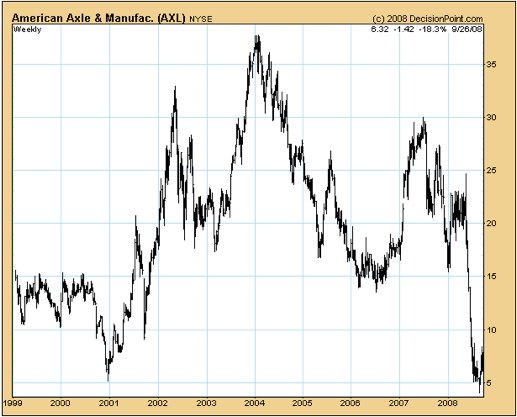
Shorting GM and Ford should be profitable but even better shorting opportunities can be found among small auto parts manufacturers who are dependent on supplying the Big 3 and are focused on making parts for gas guzzling vehicles. American Axle & Manufacturing (NYSE: AXL) fits this bill and I initiated a short position last week at $7.58. AXL manufactures driveline and drivetrain systems for light trucks and SUVs. In 2007, 78% of its sales were to GM and another 12% to Chrysler. AXL’s stock price has already collapsed, but I believe the company will file for bankruptcy in the not too distant future and the stock will go to zero.

Decision Point ®_ DecisionPoint_s Charting Workbench

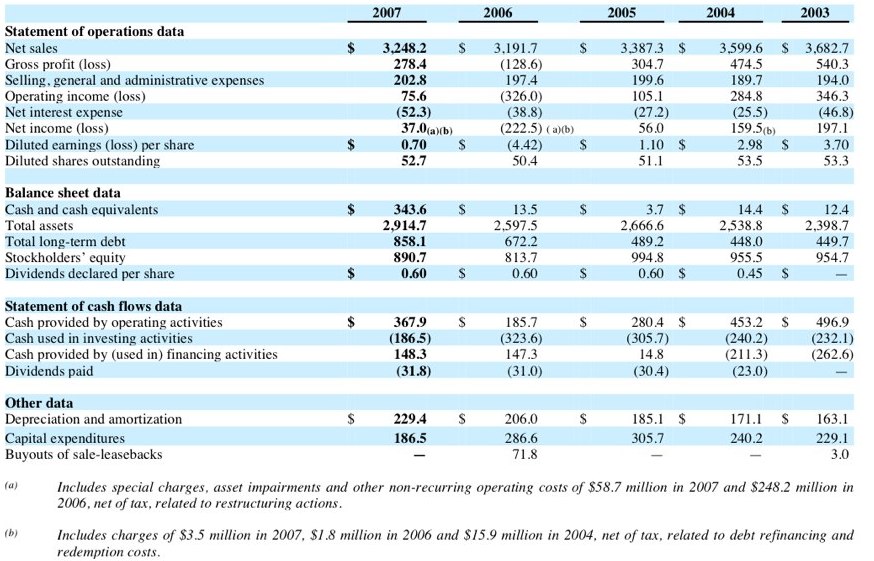
The following is AXL’s key financial data:

AXL - Google Docs

Sales have been trending lower for the last 5 years and have started to plummet in 2008.

AXL - Google Docs-1

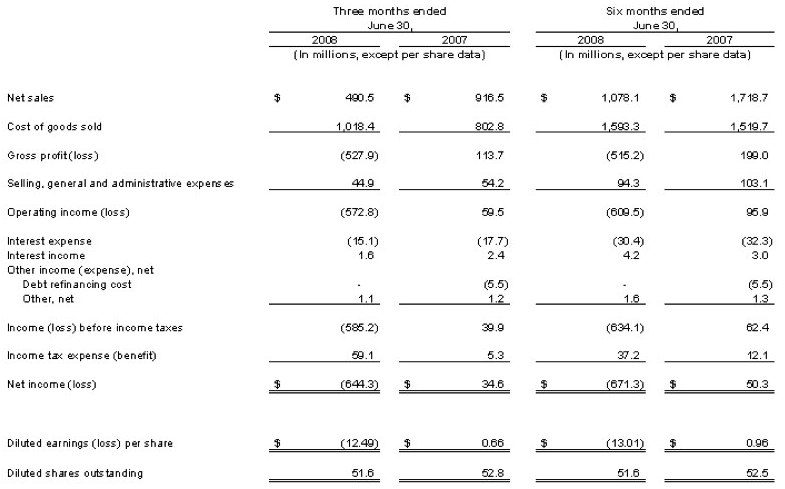
AXL’s results in the first half of 2008 were severely impacted by a strike called by the International UAW. AXL estimates the reduction in sales and operating income resulting from the International UAW strike to be $414.0 million and $129.4 million ($2.57 per share), respectively. Even if this is a correct estimate and we exclude the impact from the strike, then sales would have been 13% lower year-over-year and there would still be a loss.

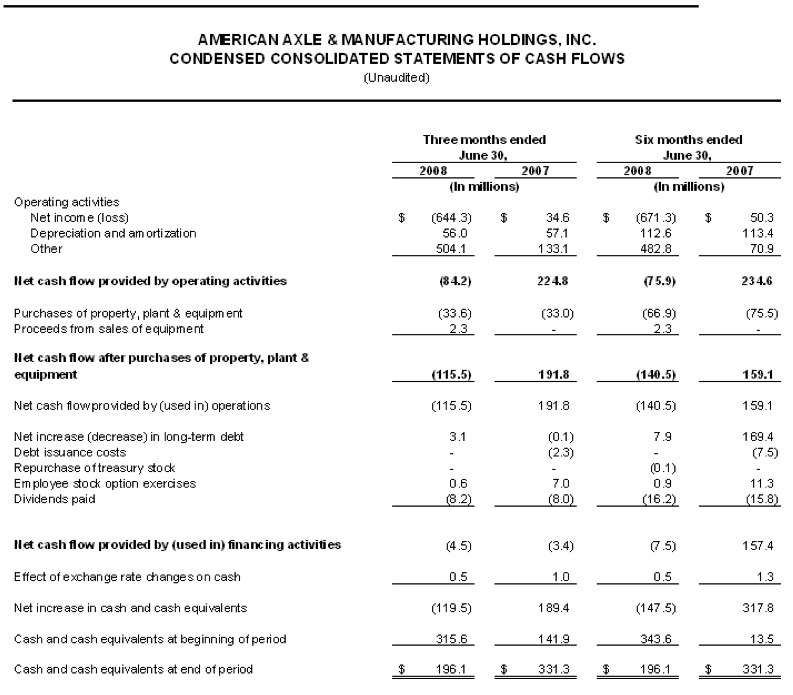
Since AXL is currently losing money the important question is how much cash is the company burning. Here is the 2nd quarter cash flow statement.

American Axle & Manufacturing Holdings, Inc. - American Axle & Manufacturing Reports Second Quarter 2008 Financial ResultsAXL had free cash flow (defined as cash flow provided by operating activities less capital expenditures) of negative $25 million and $115 million during the first and second quarters, respectively. This burn rate needs to improve as the company has only $196 million in cash.

AXL - Google Docs-2

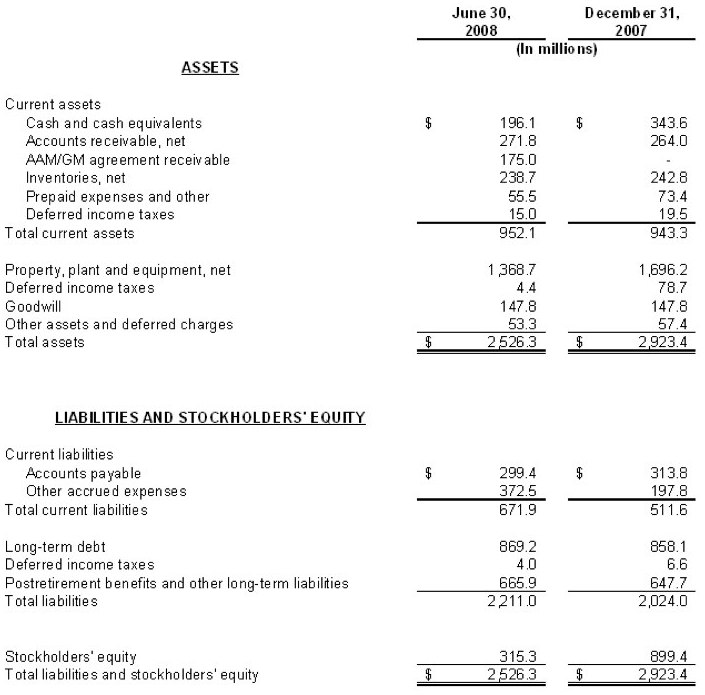
AXL does have $600 million available under a revolving credit facility. However, this facility contains financial covenants which requires AXL to comply with a leverage ratio and to maintain a minimum level of net worth.  A violation of either of these covenants could result in a default under this facility, which would permit the lenders to accelerate the repayment of any borrowings outstanding at that time. If AXL does not draw funds from this facility soon, there is a good chance it will eventually get pulled by banks who are trying to shrink their balance sheets.

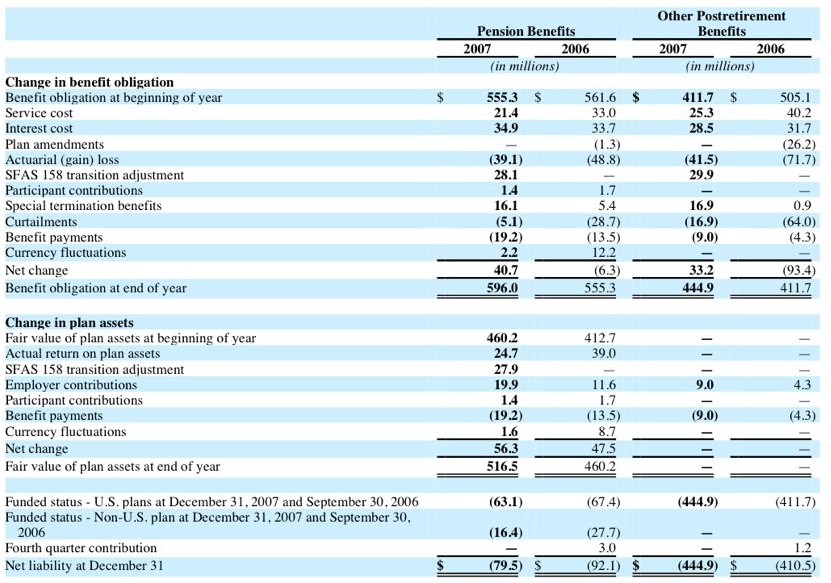
Another problem is the rising unfunded pension and postretirement benefits valued at $524.4 million at the end of 2007.

AXL - Google Docs1

This net liability is estimated using an expected return on plan assets of 8.50% and a discount rate of 6.45%. In my opinion, these are optimistic assumptions since I believe that equity prices are in a secular bear market and interest rates will rise. If so, then AXL’s cash outlays could be significantly greater.

AXL is currently trading for 30% less than the price I shorted at just last week. Although I believe the stock is heading to zero, if I had no short position I would short a little bit now and wait for a rally to increase the position. It’s my expectation that AXL along with many other US auto companies are going to struggle to survive.

Closing My Short Position in Washington Mutual

Today I covered my shorts in Washington Mutual (NYSE: WM) at $2.25. I shorted WaMu in April at $11.94. It is my view that the nation’s largest savings and loan institution is insolvent and deserves to fail. However, Merill Lynch, too, deserved to go bankrupt but was bought out by Bank of America at a ridiculously high premium. Could Washington Mutual similarly be taken over at a big premium? According to Britain’s Daily Mail newspaper, JPMorgan Chase is in advanced talks to buy Washington Mutual. So far no other source is confirming this story, but it can happen.

WaMu’s deposits have declined over the last few months so if any other bank finds value in the company as a whole, now is the time to buy before there is a massive run on the bank. After Bank of America offered a mind boggling premium to Merill Lynch, I am now afraid that another large premium could be forthcoming for WaMu, though I would assign a small probability to this outcome.

With the value of my WaMu short position having shrunk by 81%, I don’t stand to gain a lot more even if the FDIC proceeds with a takeover causing the stock to fall to zero. Therefore, I took profits and closed my short position to look for other shorting opportunities. I’m still short calls on WaMu which have a strike price of $10 and expire in January 2009 because I just don’t see how any possible takeover by another bank will value the stock above $10 and the options should expire worthless.