Altius Minerals (TSX: ALS, Pink Sheets: ATUSF) is my favorite stock and the largest holding in my portfolio. I initially purchased the stock in 2004 at about C$3.75, but I have recently added to my position at prices as high as C$23.60.
Altius started up exactly ten years ago as a small grass roots mineral exploration company. Management’s mission was to leverage its intellectual capital by identifying promising early stage projects in the province of Newfoundland and Labrador and joint venturing them to partners who could earn partial ownership interests by funding their development. The joint venture model allowed the company to reduce cash burn and equity dilution while gaining exposure to a number of promising projects.
History of Success
In 2003, Altius paid $13.6 million to acquire a 0.3% net smelter royalty on the Voisey’s Bay nickel deposit in Labrador. The company hoped that the revenue stream from the royalty would fund entire future exploration expenses. Since then the nickel price has doubled and resource estimates have increased at Voisey’s Bay. Using a conservative $7/lb nickel price and $1.50/lb for copper, Altius’ royalty is worth $58 million.
In 2005, Altius packaged its Rambler copper-gold project and sold it to a newly formed company called Rambler Mines (TSX: RAB) in return for a 30% equity interest in Rambler. At today’s prices, the equity interest is worth $16 million. Altius total investment in the Rambler project amounted to only $500,000.
Similarly, in 2006, Altius spun of its uranium projects into a new company called Aurora Energy (TSX: AXU). Since then Altius has sold $65 million of Aurora stock and still retains a stock position worth $90 million. That is, Altius gained $155 million from an investment of less than $1 million in its uranium properties.
Not surprising, Altius shareholders have been rewarded with a 5-year compound annual growth rate in the share price of 80%. This year alone the stock is up 155%. One would think that it would be impossible for management to deliver these kinds of returns to investors again, but with its recent entrance in the oil refining business they may be able to pull it off.
Newfoundland and Labrador Refining Corporation
On February 9, 2006, Altius announced that it had acquired a founding stake in a new private company called Newfoundland and Labrador Refining Corporation (NLRC) that would evaluate the economic viability of an oil refinery at Placentia Bay in Newfoundland and Labrador. Altius acquired an initial 37.5% stake with the remaining equity divided among three European investors: Dermot Desmond, founder of Dublin-based International Investment and Underwriting; Scottish financier Harry Dobson; and Stephen Posford, former head of European operations for investment bank Salomon Brothers.
NLRC’s feasibility study concluded that a 300,000 barrel per day (bpd) oil refinery costing $4.6 billion, which would rank among the largest and most advanced crude oil processing plants in the world, would be economically viable. The refinery could be completed and begin processing oil by 2011, with the option to expand capacity to 600,000 bpd.
The refinery is to be built on Placentia Bay in southeastern Newfoundland, on Canada’s Atlantic coast, a location picked to take advantage of high demand for petroleum products in the U.S. Northeast. Placentia Bay is located on the main transatlantic shipping route between North America and Western Europe and is one the deepest ice-free ports in North America, able to accommodate Very Large Crude Carrier (VLCC)-size vessels year-round. The region is currently home to a large industrial workforce and features established infrastructure that has supported other large oil industry related development projects.
There is an existing 115,000 barrel per day refinery at Placentia Bay owned by Harvest Energy (NYSE: HTE). It is expected that NLRC’s refinery will be of a different configuration than Harvest’s and will therefore not be a competitor.
NLRC believes the best market opportunity for a new refinery in the Atlantic Basin is one that focuses on efficient processing of medium to heavy sour crude oil feedstocks. Such crude oil types are typically priced at a discount since they represent the bulk of global oil reserves and an increasing share of global crude oil production. The optimal suggested product mix is one that maximizes production of transportation fuels, especially ultra low-sulphur diesel and jet fuel, as there are projected shortages for these products in markets in both Europe and North America.
NLRC has received a positive decision from the provincial environmental process, thereby clearing a major permitting hurdle. The company has also signed an engineering procurement and construction management contract with SNC-Lavalin and finalized an agreement with Japan’s IJK consortium for the fabrication of heavy-walled steel reactor vessels. The remaining challenges are securing commercial agreements on feedstock supply and product off take as well as obtaining debt and equity financing.
Recently Altius completed a bought deal financing at $28 per share for gross proceeds of $50,400,000. The proceeds are to be used to increase Altius’ stake in NLRC to up to 51%. To see why Altius’ equity stake in NLRC could turn out to be a huge money maker it is necessary to analyze the economics of oil refining.
Shortage of Refining Capacity
A refinery makes money by purchasing oil and converting it to usable products such as gasoline, diesel, and jet fuel. The difference between the price received for refined products and the purchase price of oil is called the crack spread and determines how profitable a refiner is.
Numerous refineries were constructed during the 1970s to take advantage of high energy prices; but the resulting collapse in demand for refined products led to a glut of capacity and declining refining margins throughout the 80s and 90s. Unsatisfactory return on investment, obsolescence, tight environmental restrictions, and not-in-my-back-yard community opposition forced the closure of half of the refineries operating in 1980 and kept a new refinery from being built since then. Instead refiners made upgrades at existing profitable sites to expand capacity and keep up with demand.
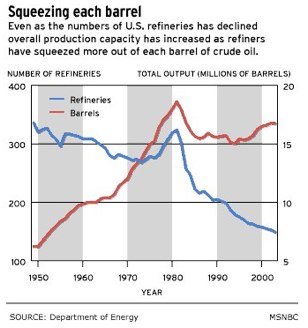
However, to meet continued growth in demand experts estimate the U.S. would have to boost refining capacity by another 250,000 bpd — every year. But it is not clear just how much further U.S. refiners can stretch production. On a worldwide basis crude demand has been rising steadily during this time and has now caught up with capacity creating the need for brand new refineries:

New Complex Refineries Are Needed
When crude oil is refined, it produces several products, including gasoline, diesel and jet fuel. Depending on how a refinery is configured, it will produce varying amounts of these products from a single barrel of crude. In decades past, European refiners invested heavily in refining equipment that emphasized gasoline production. But a renewed groundswell in Europe in the past decade to reduce carbon dioxide and other greenhouse-gas emissions, as well as improvements in diesel technology, have accelerated the Continent’s drive towards diesel fuel.
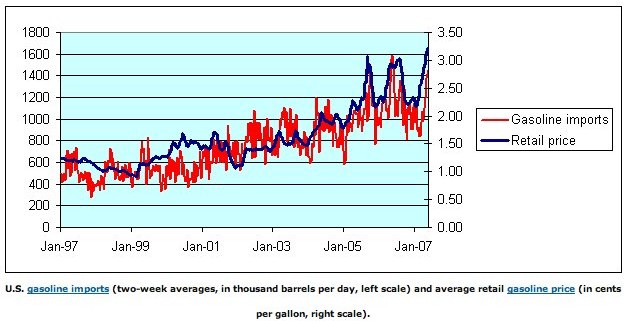
As a result, Europe has a shortage of diesel and a glut of gasoline, which is exported to the U.S. As shown below, the U.S. has become increasingly dependent on gasoline imports:
The crude oil that is purchased as feedstock for refining operations could be the light sweet crude oil that trades on the NYMEX, which is light due to high API gravity and sweet due to low sulfur content. On the other hand, refineries could purchase a cheaper crude grade that is heavy, or sour, or both, but which would require unique refining parameters.
The lack of U.S. spare refining capacity coupled with the inability of existing refineries to utilize heavy sour crude and produce the optimal mix of products to match demand has led to rising crack spreads. As the following tables show, the spread between West Texas Intermediate (WTI) light sweet oil and Mexican Maya heavy sour oil has been widening since 2002. If NLRC was in operation now and it utilized 100% Maya crude as feedstock, rather than WTI, it would enjoy a gross margin of approximately $26.
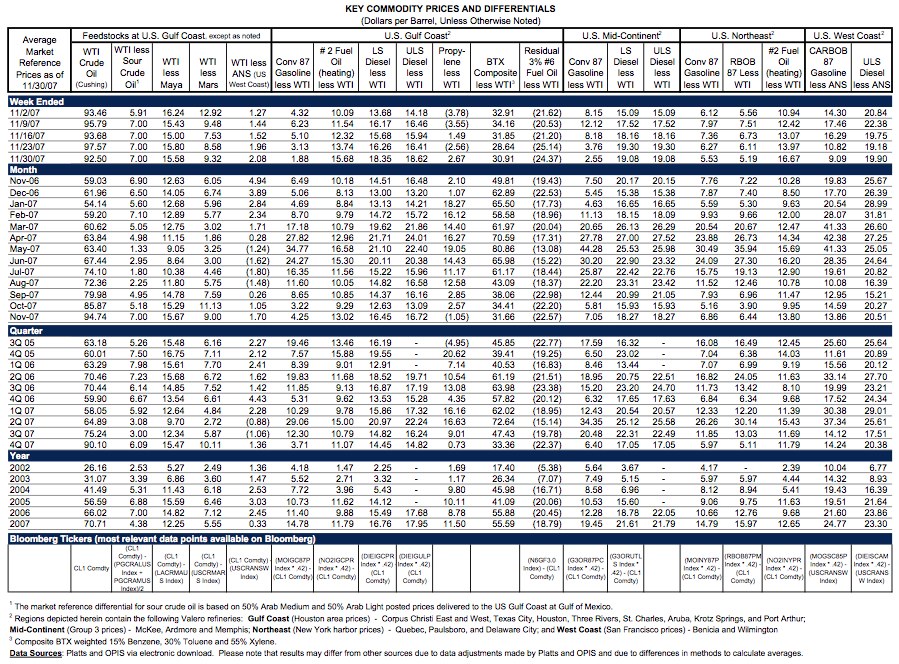
Maya is selling at a substantial discount to light sweet because a growing proportion of oil production is of the heavy sour type. Furthermore, North American refineries, almost all of which were built over 25 years ago when light sweet was plentiful, are not configured to process oil that is heavy and sour. Thus, stagnant demand and growing supplies has made Maya a relatively cheap feedstock for refineries that are complex enough to process it.
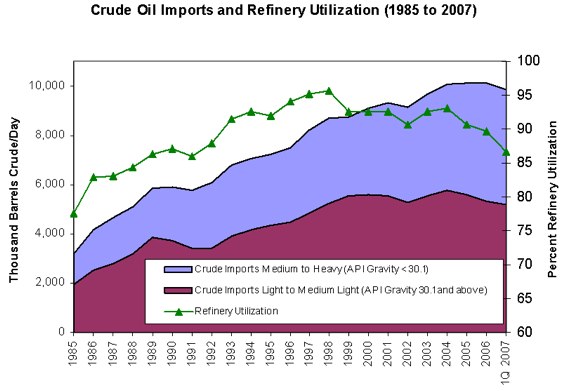
The following graphic indicates that the WTI-Maya spread is likely to continue increasing over the next 10 years:
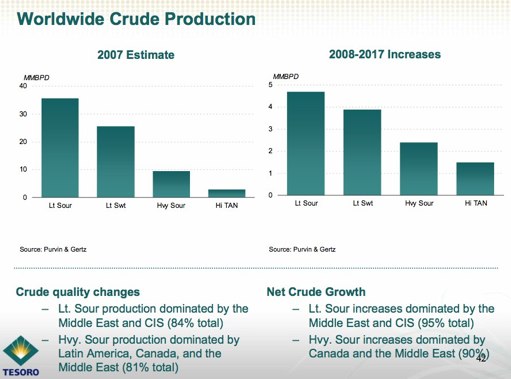
I do not subscribe to the theory of Peak Oil, though as I implied in this post, I do believe that we have peaked in the production of light sweet crude. The world has plenty of oil left in places like the Athabasca tar sands and the Colorado oil shales, however a growing proportion of the oil to be produced will be of the heavy sour type.
Whereas supply has become increasingly poorer in quality, the demand for products has risen rapidly. Also, the quality requirements for light products have become ever more strict. Sulfur levels in transportation fuels have tightened significantly in recent years. Nearly 40 per cent of the world’s crude distillation capacity is more than 25 years old and cannot be overhauled to meet the new requirements. With global warming becoming an ever popular issue, this trend will remain intact for the foreseeable future.
Thus, we are now in an environment where building a new complex refinery makes sense. However, as mentioned tightening environmental standards coupled with the fact that most people do not want a refinery in their backyards means there are no current plans for a greenfield refinery in the U.S. Since it takes 4 to 5 years to construct a refinery from scratch, the growth in demand for refined products over this time period will have to be met by expanding capacity at existing U.S. refineries and through imports.
However, current refineries are less efficient at converting heavy sour feedstock as evidenced by the frequent outages experienced by refineries recently. Therefore, NLRC, which will have one of the most complex refineries in the world, will enjoy a significant competitive advantage and will be able to capture the highest margins.
New International Refinery Projects
Companies in India, China and the Middle East are rapidly building refineries to meet surging demand, adding capacity that could bring down prices. Global refining capacity is expected to grow 1.7% a year for the next five years, a significant rate of increase for a traditionally slow-moving industry, according to Cambridge Energy Research Associates. NLRC’s target markets for its refined products will be the U.S. Northeast (for gasoline and jet fuel) and western Europe (for diesel). Given Placentia Bay’s proximity to these locations, NLRC will be able to deliver its refined products more cheaply than Asian refineries.
Recently, Irving Oil submitted an environmental plan for constructing a new 300,000 bpd refinery in nearby New Brunswick with the plan to start up around 2012. There is some opposition from the communities near the proposed site and environmental permits will still need to be granted from the province. But even if the project gets the green light to proceed, it should not pose a threat to NLRC. Considering that the US is under supplied by 4 million bpd of refined product, two 300,000 bpd refineries on the Atlantic coast can certainly coexist and thrive.
Eventually, rising crack spreads will lead to several new refinery projects in the U.S. But since none have been currently announced, NLRC should enjoy a number of lucrative years before capacity does eventually catch up to demand. As Altius’ Vice President of corporate development, Chad Wells stated, “We recognize to a certain degree there is a race in place in the sense of filling this capacity — this insatiable northeastern U.S. market as well as diesel demand in Europe.”
Valuing Altius
The cost of constructing the refinery has been estimated at $4.6 billion, but I would not be surprised to see it cost much more than that. To be very conservative, I will assume a price tag of $6 billion. NLRC has yet to secure debt financing, but I expect its capital structure would be comprised of something like two-thirds debt and one-third equity.
Therefore, stock holders will have to foot $2 billion of the bill, of which $1 billion will need to be contributed by Altius if it wanted to own 51% of NLRC equity. Obviously, Altius cannot afford that and will have to suffer dilution during further equity rounds. However, I think it is likely that Altius can hold onto at least 15% of NLRC’s equity. Under this scenario, Altius would have to contribute approximately $150 million, which is easily manageable considering the company is sitting on $165 million in cash.
If NLRC were operating today, it would enjoy gross margins of $26/barrel and an operating margin of $20/barrel. If we assume that the refinery manages to utilize 90% of its 300,000 barrel/day capacity, then the company would earn nearly $2 billion per year. Most refiners are currently trading for 5 times operating income which means NLRC would be valued at $10 billion. Thus Altius’ 15% stake would be worth $1.5 billion.
In addition, Altius owns a 62% stake in a 1% to 10% sliding scale royalty based on gross refining margins between $4 and $20. Assuming Altius is able to keep this royalty through to production, and I see no reason why they will not be able to, Altius’ royalty would amount to $120 million per year. If a valuation multiple of 10 was to be applied to the annual royalty, it would be worth $1.2 billion. Thus, Altius’ NLRC stake would be worth $2.7 billion or $90 per Altius share. If Altius’ other assets were included the stock could be worth $100 by the time NLRC begins operation.
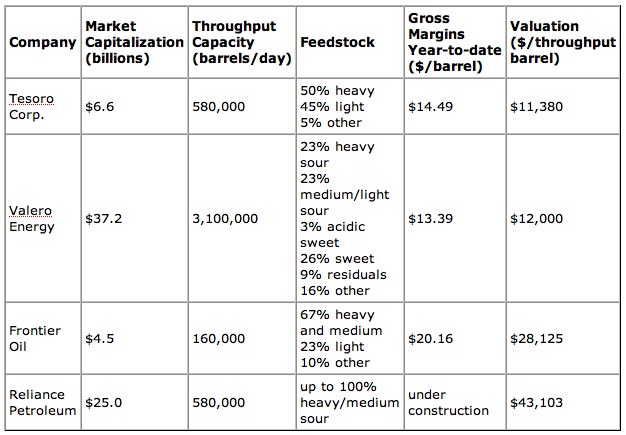
In a recent research report by Haywood Securities, NLRC’s valuation was extrapolated by comparing it to another pure play refiner, Reliance Petroleum, which has only one asset: a 580,000 bpd Indian refinery scheduled to begin operating by this time next year. It will have a complexity of 14.0, using the Nelson Complexity Index, ranking it amongst the highest in the sector and similar to NLRC’s proposed refinery. Reliance Petroleum currently trades on the Bombay Stock Exchange and is priced at over $40,000 per barrel of capacity. Applying this valuation to NLRC yields a value of $12 billion. Altius’ share of this $12 billion plus the royalty would make its stock worth $110.
As the following table shows, there is a premium attached to the valuations of complex refiners:
Markets do work and and eventually huge refining profits will attract several new refinery projects. However, permitting and construction takes at least 5 years and NLRC is well ahead of anyone. If for some reason the refinery project fails to be completed, Altius’ share price will collapse to its net asset value of $10. But given the track record of the management team and the project is backed by several prominent investors and the government of Newfoundland and Labrador, I am betting that the refinery will get built. In conclusion, I believe Altius is a cheap, though speculative, way to play the complex refining theme.
