Category Archives: Trades

Shorting US Treasury Bonds

Last Thursday I shorted 30 year US Treasury bonds futures which trade on the Chicago Board of Trade. I sold the December contract for $118.28. This is only a short-term trade based on my belief that the plan for governments around the world to directly recapitalize banks, guarantee interbank lending, and provide a blanket guarantee on all deposits would be enough to prevent a total financial system meltdown and restore confidence in banks.

There are several ways to play this from going long equities to buying Euros. The trade I feel most comfortable with is to bet on rising interest rates on government debt securities which have plummeted due to a flight quality. The 30 year treasury bond looks the most overvalued because the government will have to print a lot of money in the future to pay for all these bailouts. However, other than a short term correction in Treasury bonds I expect its price to remain firm as headline inflation begins to drop dramatically over the next year leading the market to fear deflation. I will probably close out the position at around $112.

Covering Short Position in American Axle & Manufacturing

Today I covered my short position in American Axle & Manufacturing (NYSE: AXL) at an average price of $3.12 for a profit of 59% from where I initiated the position just two weeks ago. The stock has collapsed along with the general stock market and I am hoping that there could be a decent short-term bounce that will allow me to short the stock again. I don’t think the company or any of the major auto manufacturers can survive much longer.

Covering Short Position in SunTrust Banks (NYSE: STI)

I have covered my short position in SunTrust Banks (NYSE:STI) at an average price of $33.22 for a profit of 26% in four weeks. As I have explained, SunTrust is worth significantly less than my covering price because the bank has still not taken the necessary write downs which will force it to raise capital. However, the stock market is incredibly oversold and due for a sharp counter trend rally. If that rally takes SunTrust back up to the low- to mid-forties than I might short the stock again.

Shorting American Axle & Manufacturing

I am of the opinion that the US economy has just slipped into the worst consumer spending slump in decades. This will lead to a sharp pullback in big ticket purchases. Automobile sales, which tend to be financed, are especially vulnerable given the current problems in the credit markets. Moreover, the average US household owns almost two vehicles meaning that the market is saturated. Most new demand will come from replacement and this need, too, is declining as cars released in recent years are lasting longer. Another consideration is the rise in energy prices which is leading to a shift in demand from SUVs and light trucks to more fuel efficient cars.

The US auto companies are already in trouble due to their significantly greater cost of labor compared to their Asian competitors. European manufacturers also face this challenge, but their efficiency and technological superiority have allowed them to carve out a niche in the luxury market where they can more easily pass on their costs to their customers. GM, Ford, and Chrysler have been losing market share for years and are burning cash at an alarming rate. Bankruptcy is only a question of time.

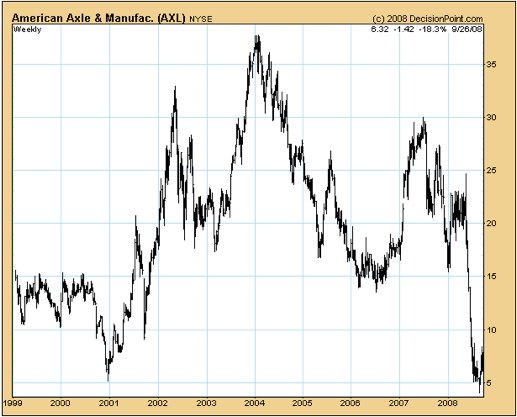
Shorting GM and Ford should be profitable but even better shorting opportunities can be found among small auto parts manufacturers who are dependent on supplying the Big 3 and are focused on making parts for gas guzzling vehicles. American Axle & Manufacturing (NYSE: AXL) fits this bill and I initiated a short position last week at $7.58. AXL manufactures driveline and drivetrain systems for light trucks and SUVs. In 2007, 78% of its sales were to GM and another 12% to Chrysler. AXL’s stock price has already collapsed, but I believe the company will file for bankruptcy in the not too distant future and the stock will go to zero.

Decision Point ®_ DecisionPoint_s Charting Workbench

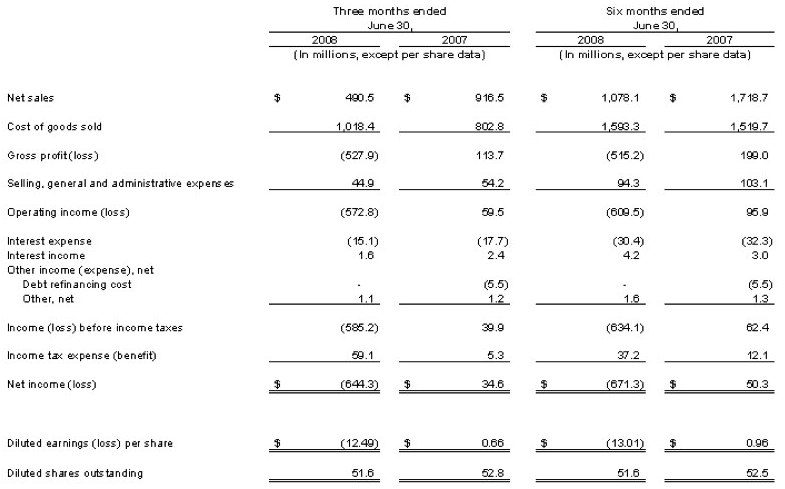
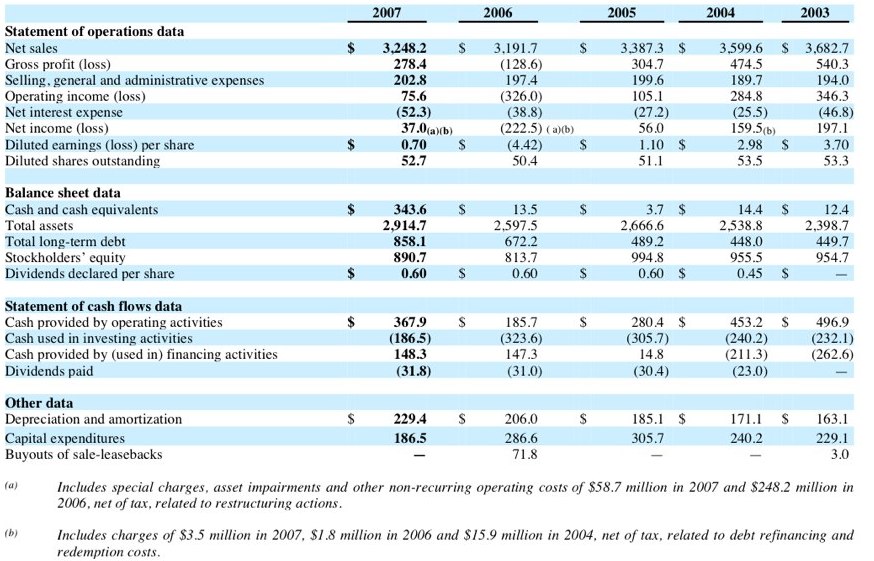
The following is AXL’s key financial data:

AXL - Google Docs

Sales have been trending lower for the last 5 years and have started to plummet in 2008.

AXL - Google Docs-1

AXL’s results in the first half of 2008 were severely impacted by a strike called by the International UAW. AXL estimates the reduction in sales and operating income resulting from the International UAW strike to be $414.0 million and $129.4 million ($2.57 per share), respectively. Even if this is a correct estimate and we exclude the impact from the strike, then sales would have been 13% lower year-over-year and there would still be a loss.

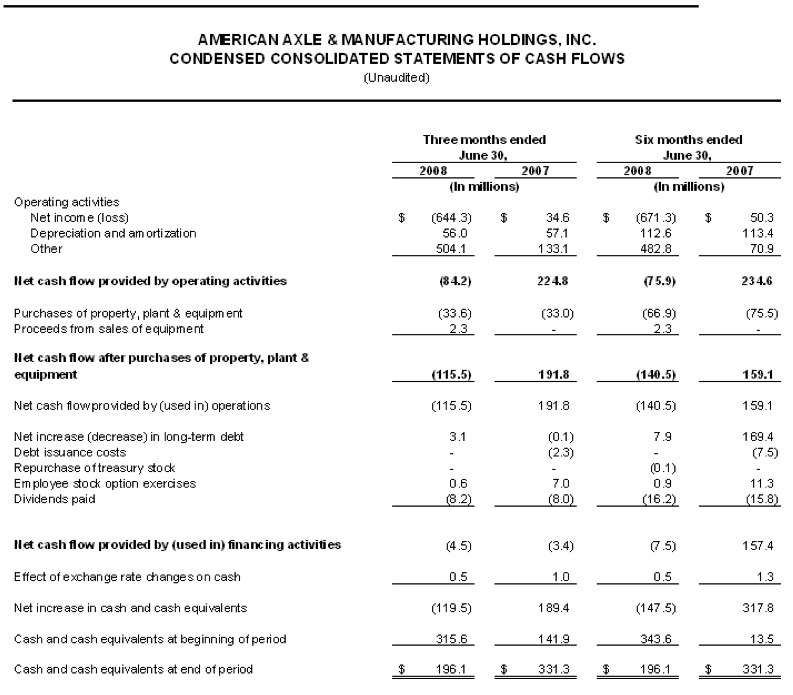
Since AXL is currently losing money the important question is how much cash is the company burning. Here is the 2nd quarter cash flow statement.

American Axle & Manufacturing Holdings, Inc. - American Axle & Manufacturing Reports Second Quarter 2008 Financial ResultsAXL had free cash flow (defined as cash flow provided by operating activities less capital expenditures) of negative $25 million and $115 million during the first and second quarters, respectively. This burn rate needs to improve as the company has only $196 million in cash.

AXL - Google Docs-2

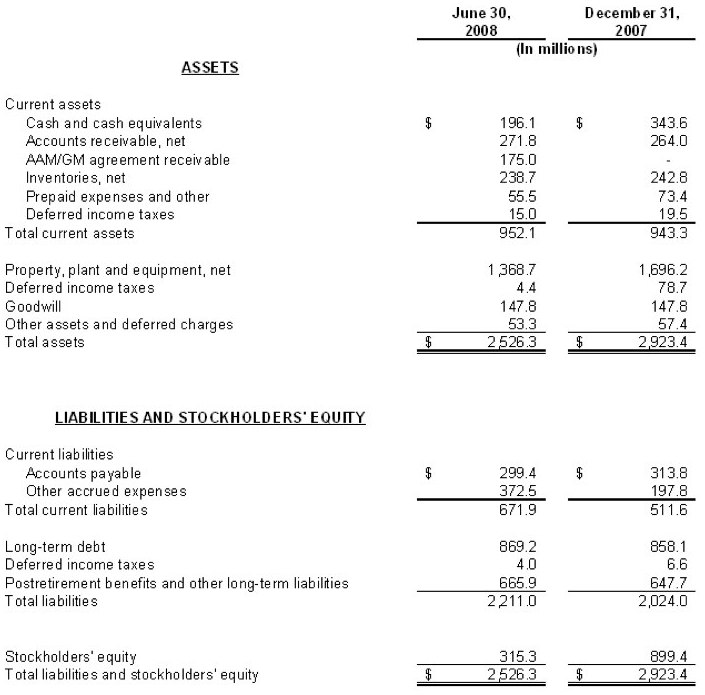
AXL does have $600 million available under a revolving credit facility. However, this facility contains financial covenants which requires AXL to comply with a leverage ratio and to maintain a minimum level of net worth.  A violation of either of these covenants could result in a default under this facility, which would permit the lenders to accelerate the repayment of any borrowings outstanding at that time. If AXL does not draw funds from this facility soon, there is a good chance it will eventually get pulled by banks who are trying to shrink their balance sheets.

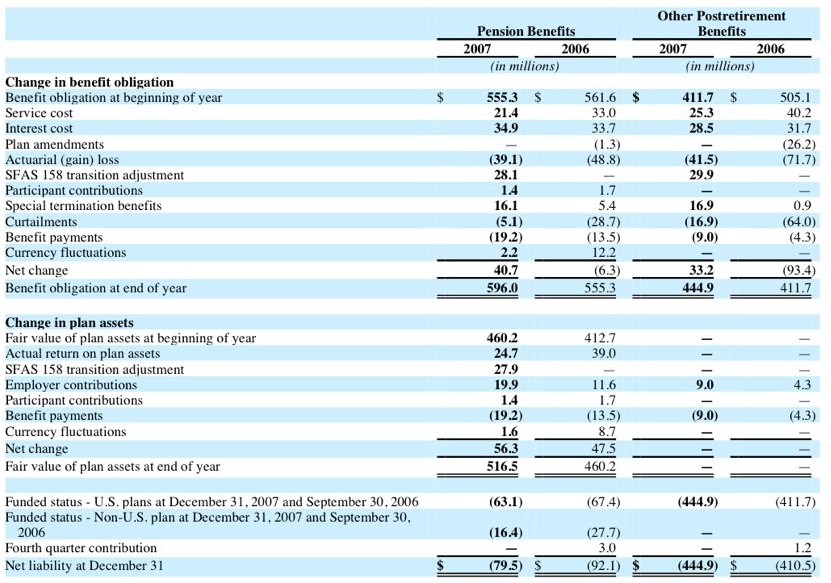
Another problem is the rising unfunded pension and postretirement benefits valued at $524.4 million at the end of 2007.

AXL - Google Docs1

This net liability is estimated using an expected return on plan assets of 8.50% and a discount rate of 6.45%. In my opinion, these are optimistic assumptions since I believe that equity prices are in a secular bear market and interest rates will rise. If so, then AXL’s cash outlays could be significantly greater.

AXL is currently trading for 30% less than the price I shorted at just last week. Although I believe the stock is heading to zero, if I had no short position I would short a little bit now and wait for a rally to increase the position. It’s my expectation that AXL along with many other US auto companies are going to struggle to survive.

Closing My Short Position in Washington Mutual

Today I covered my shorts in Washington Mutual (NYSE: WM) at $2.25. I shorted WaMu in April at $11.94. It is my view that the nation’s largest savings and loan institution is insolvent and deserves to fail. However, Merill Lynch, too, deserved to go bankrupt but was bought out by Bank of America at a ridiculously high premium. Could Washington Mutual similarly be taken over at a big premium? According to Britain’s Daily Mail newspaper, JPMorgan Chase is in advanced talks to buy Washington Mutual. So far no other source is confirming this story, but it can happen.

WaMu’s deposits have declined over the last few months so if any other bank finds value in the company as a whole, now is the time to buy before there is a massive run on the bank. After Bank of America offered a mind boggling premium to Merill Lynch, I am now afraid that another large premium could be forthcoming for WaMu, though I would assign a small probability to this outcome.

With the value of my WaMu short position having shrunk by 81%, I don’t stand to gain a lot more even if the FDIC proceeds with a takeover causing the stock to fall to zero. Therefore, I took profits and closed my short position to look for other shorting opportunities. I’m still short calls on WaMu which have a strike price of $10 and expire in January 2009 because I just don’t see how any possible takeover by another bank will value the stock above $10 and the options should expire worthless.

Closing My Position in Fed Funds Futures

I just closed my long position in the federal funds futures contract for February 2009 at 98.24. The contract is spiking higher tonight as it looks increasingly likely that a bankruptcy filing is forthcoming from Lehman Brothers. My average cost was 97.17 and in just 11 weeks I have realized a profit of around $4500 per contract compared with an initial margin requirement of $1350 per contract.

The market is starting to realize that the banking system is facing a meltdown with interest rate spreads sharply widening. As such, the Fed cannot increase its key lending rate. And with the recent collapse in commodity prices and a stronger dollar, further rate cuts look quite likely. I believe the Fed will cut rates, but I don’t know if it will cut rates by more than 25 basis points over the next few months. Therefore, I decided to take profits in my fed funds futures contract and look for other opportunities.

Shorting SunTrust Banks (NYSE: STI)

Over the last few weeks I have been taking advantage of the rally in financial stocks to accumulate a short position in SunTrust Banks. My average price is $42.93, but I do plan to short more shares if the price continues to rise. As I have explained previously, US banks are facing a massive credit bust that will lead to hundreds of institutions becoming insolvent. To profit from the situation I am shorting some of the banks which I think have a high probability of failing. Washington Mutual is one. SunTrust is another.

SunTrust’s core market is the US Southeast, namely Florida and Georgia. Florida is right up there with California as having the worst housing markets in the country. I believe SunTrust’s exposure to Florida real estate along with its thin capital cushion will cause it to struggle to survive. In particular, the bank has a huge portfolio of construction & development loans amounting to 115% of its tangible equity.

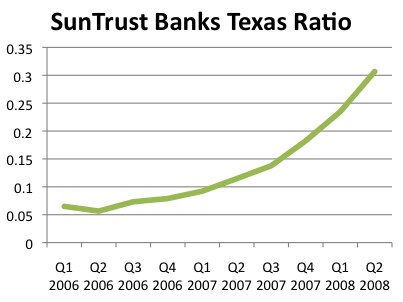
Already SunTrust’s loan portfolio is showing a disturbing trend. Below is a chart of SunTrust’s Texas Ratio, which is calculated by dividing non-performing assets including loans more than 90 days delinquent by the bank’s tangible equity plus loan loss reserves.

SunTrust Texas Ratio

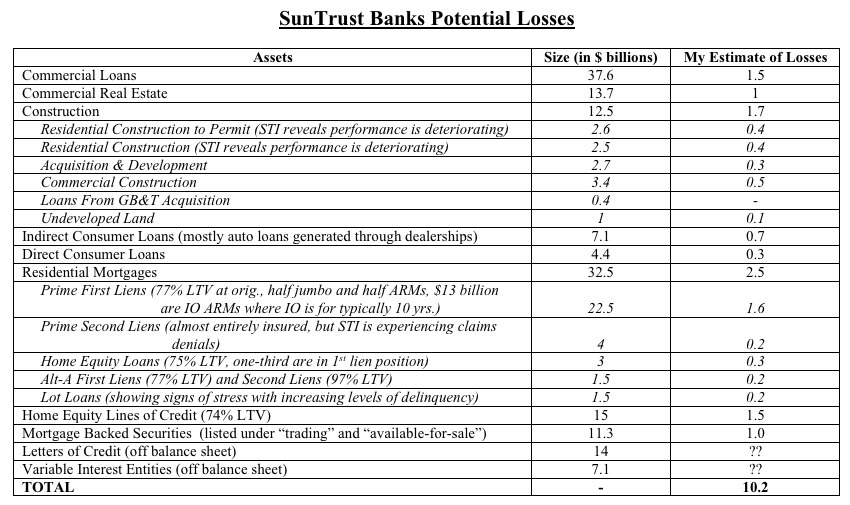
The following is my estimate of the writedowns that SunTrust will have to take over the next two years. The economic environment that I have assumed is one in which the US will fall into a prolonged recession marked by unusually high numbers of personal and corporate bankruptcies.

SunTrust Banks Losses

If SunTrust were to lose $10 billion, it would be left with little tangible equity. But before its tangible equity gets to close to zero, regulators would force it to raise capital. Since this would be very dilutive to existing shareholders, the stock would sell off sharply making any possible offering so dilutive that it would be nearly impossible. This would be a similar situation to what Freddie Mac faced and what Lehman Brothers and Washington Mutual currently faces. If SunTrust is unable to raise capital then at some point depositors will get nervous and pull their funds, thereby creating a liquidity problem for SunTrust and forcing it to be taken over by the FDIC.

To summarize, I think betting against banks is a good speculation in the current climate and SunTrust is, in my opinion, one of the weaker institutions.

Selling MBIA Calls

One year ago, I initiated a short position in MBIA (NYSE:MBI) based on a compelling presentation by hedge fund manager Bill Ackman. I shorted the stock at $61.29 and closed the position two months later at $46.47. My reasoning for ending the trade at the time was that MBIA had not disclosed in detail its CDO and RMBS exposures so in my mind there existed a possibility for MBIA to absorb the losses and survive. Unfortunately, shortly after closing out my position MBIA did provide more color on its insured structured finance portfolio and it wasn’t pretty. Before I could short the stock again, its price plummeted.

In April, I finally decided to pull the trigger and reopen my MBIA short position. Unfortunately, my broker was having difficulty locating stock to short. So I thought I would take advantage of the volatility of the stock price to sell MBIA January ‘09 calls with a strike price of $10 for $4 each. Until a few weeks ago I was sitting on a wonderful gain on this position as the options looked likely to expire worthless. However, recently MBIA’s share price has staged a miraculous recovery tripling to its current price of around $16 giving it a market cap of $4.4 billion for the first time since last November when its share price was $35 (MBIA has more than doubled its share count this year via secondary offerings).

Part of this rally is probably due to short covering as MBIA is one of the most heavily shorted stocks on the NYSE. But the ignition for the fire was provided by MBIA’s 2nd quarter earnings release as well as news that the company has reinsured a large public finance portfolio from FGIC. None of these events change my expectation that MBIA is going to face staggering losses in its structured finance portfolio that could render it insolvent. So last week I took advantage of the strength in the stock and sold some more January ‘09 calls, this time with a strike price of $15 for $3.30.

One’s opinion on whether MBIA is a buy or a sell largely depends on his macroeconomic outlook. If the current credit crisis begins to subside by early next year and the downturn in the economy is mild with a decent recovery similar to 2001, then defaults leading to claims in MBIA’s insured portfolio will not rise much from current levels and the company will return to positive operating cash flow by 2010. On the other hand, it is my belief that we are in the midst of the worst financial crisis since the Great Depression and a recession that will last beyond 2009. Personal and corporate bankruptcies will surge to levels not seen in decades and MBIA will be inundated with claims.

To conservatively estimate MBIA’s losses, I have assumed an outlook that is between the two that I have described above. Below are my estimates along with Bill Ackman’s from his Open Source Model.
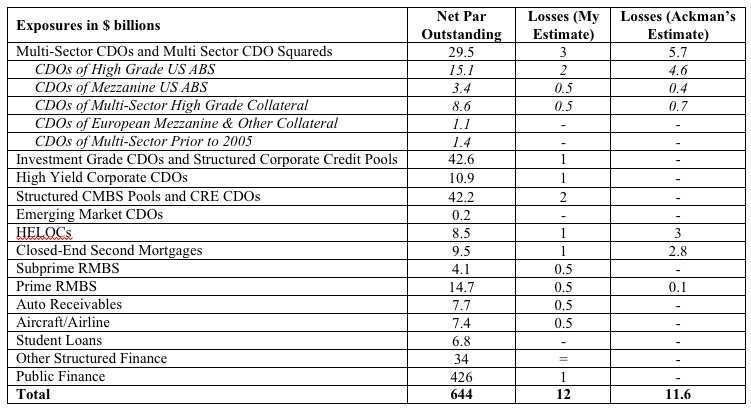
MBIA Projected Losses

We both calculated a $12 billion loss. While he is projecting greater losses arising from MBIA’s multi-sector CDOs and second lien mortgages exposures, I am including additional losses in corporate CDOs, CMBS, auto receivables, student loans and public finance.

This is because I believe the current problems in the mortgage market are symptoms of a greater problem: a general mispricing of risk. Ultra-expansionary monetary policies conducted by the Federal Reserve in years past encouraged lenders to lend capital at terms and interest rates that didn’t adequately compensate them for the risk they were taking. This was prevalent in commercial real estate, corporate borrowing, consumer credit, municipal bonds, as well as the housing market. Now that the economy is likely in a recession, defaults will rise across the board.

Another risk MBIA faces is that it has reinsured $41.7 billion of its portfolio with Channel Re, a company which MBIA owns a minority stake in and counts MBIA as its only customer. Approximately half of the reinsured portfolio is comprised of CDOs meaning that ChannelRe is at a high risk of collapsing. If so, the reinsured policies would come back onto MBIA’s books. Using my estimate of approximately 6% loss on MBIA’s CDO exposure to calculate Channel Re’s loss on its $20 billion of CDO exposure results in a further loss to MBIA of $1 billion. Therefore, in total I expect $13 billion in losses.

If MBIA’s insurance subsidiary (MBIA Corp.) were to suffer $13 billion in losses, I don’t think it will be able to survive. MBIA would surely disagree and state that it has $16 billion in claim paying resources. The problem is that the losses will almost entirely come from structured finance credits which are of much shorter duration compared to public obligations. This means that MBIA would be swamped by claims over the next few years. As its capital base dwindles, its claims paying ratio would skyrocket resulting in further downgrades from the rating agencies. Basically, I don’t think the holding company and MBIA shareholders will receive another dividend from the insurance subsidiary.

The recent loss of MBIA’s triple-A status has resulted in an inability to write any new public finance policy of significance and the company has decided to withdraw from the structured finance business. Now its sole sources of cash flow are interest income and structured finance premiums on policies written in the past. (Premiums from public finance policies were paid upfront). Adding salt to the wound, the company’s 2nd lien mortgage exposures have resulted in a rising number of claims and a 2nd quarter that generated zero cash flow. If there are additional claims in the 3rd quarter MBIA will start burning cash. As the following chart suggests, 2nd lien RMBS claims have been surging over the past 3 quarters.
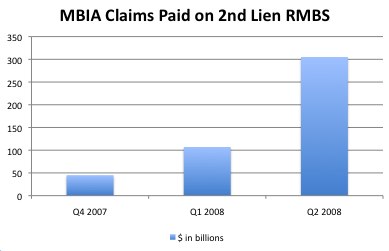
MBIA Claims Paid

Surprisingly, MBIA is not expecting a significant further rise in claims as it has reserved only $796 million in RMBS losses (2% of RMBS gross net par) and $243 million in other losses. In addition, the company has only booked $1,040 million in impairments related to its CDO exposure (0.8% of its CDO gross net par). This is significantly lower than what the market thinks based on market prices or what investment banks have already accepted as losses. Is it possible that MBIA was more stringent in what it insured resulting in a portfolio of better quality? Not according to Ackman:

From 2005-2007, the total universe of ABS CDOs outstanding is comprised of approximately 534 deals. While MBIA and Ambac appear to have only limited direct exposure to this pool (having directly guaranteed only 25 and 28 CDOs, respectively), in fact, MBIA and Ambac are actually exposed to at least 420 and 389, respectively, of the 534 total CDOs outstanding if you include the CDO exposures within the CDOs they have guaranteed. The fact that MBIA and Ambac have direct or indirect exposure to 79% and 73%, respectively, of all ABS CDOs issued from 2005-2007 directly contradicts the insurers’ public statements about their “highly selective” approach to CDO guarantees.

The same can be said about MBIA’s RMBS exposure. So I don’t think the company has adequately reserved for future losses and once it does it will wipe out its capital base leading to additional downgrades.

A downgrade below AA would be problematic as it would require MBIA’s asset management subsidiary to terminate certain GICs issued to municipalities and post additional collateral on others. For example, a downgrade to triple-B would cause a maximum potential termination of $9.2 billion. This would force MBIA to liquidate at a loss most of its investment portfolio which includes instruments such CDOs and RMBS. The asset management subsidiary already has negative equity, so such a series of events would make it insolvent.

The only ray of hope for MBIA shareholders is if the holding company is successful in starting a new monoline insurance subsidiary with a triple-A rating. But I wouldn’t assign much value to this since the holding company’s balance sheet would have no equity if the investment in MBIA Corp. is excluded. So without much capital to infuse into a new insurance subsidiary, MBIA wouldn’t be able to write many policies. And considering the entry of Berkshire Hathaway as a competitor, the collapse of the structured finance market and the loss of interest in guaranteeing public credits I don’t think MBIA can make much money.

In conclusion, I think shorting MBIA or selling calls on it at today’s prices is an excellent speculative bet.
Buying Fed Funds Futures

Today I purchased the 30 day federal funds futures contract for February trading on the Chicago Board of Trade for 97.17 meaning that I do not believe that the Federal Reserve will increase the fed funds rate above 2.83% by February. The market has priced in a hike of at least 83 basis points within the next 8 months due to Bernanke’s and other committee members’ recent speeches expressing concern for the weakening dollar and rising inflation. The fear is that the Fed will follow up its hawkish talk with aggressive monetary tightening.

I think the market, which gives the Fed far more credibility than it deserves, has been hoodwinked by Bernanke and co. in the Fed’s attempt to manage inflation expectations. It is actually quite clear that the Fed will not significantly tighten anytime in the near future if we consider two facts.

First, the Fed is a private entity owned by all of the chartered banks of the US. Although congressional oversight and statute can alter the Fed’s responsibilities and control, currrently it does have the authority to act independently without prior approval from the President or Congress. Thus, while the government’s hope is that the Fed will act to promote economic growth, a sound currency, and a stable banking system — its greatest incentive is to act in the interests of its shareholders (i.e. banks).

Second, the balance sheets of banks are rapidly deteriorating as what was once thought to be an exclusively subprime problem, is now beginning to be recognized as a widespread underpricing of risk that has also affected prime real estate mortgages, commercial real estate mortgages, consumer loans, corporate credit, municipal bonds, and derivatives. US banks alone have written off a couple of hundred billions of dollars worth of subprime mortgages and writedowns related to other assets are only beginning. With only $1.2 trillion of capital within the entire US banking system, a huge flood of bank failures is looking increasingly likely.

If these two facts are put together — a Fed that acts primarily in the interest of banks and a continued deterioration in bank balance sheets — then the Fed will continue to promote an easy monetary policy. Indeed, a low Fed funds rate will promote a steep yield curve which should provide some relief to banks who are in the business of borrowing short and lending long.

That said, if oil prices begin to rise parabolically and/or the US dollar depreciates rapidly, it would not surprise me to see the Fed hike by 25 basis points to persuade the markets that it is about to embark on a tightening mission. However, the 83 basis points increase in the Fed funds rate that the futures market is pricing in by February, in my view, has a very small chance of becoming reality.