Consumer spending although not robust, has been growing despite the ongoing recession in the residential real estate sector. I have suggested some possible reasons why there is a lag between when the housing bubble started to collapse and when we would see a substantial decline in consumption.
But another important factor which I failed to mention was the healthy spending by high-income individuals who do not concentrate most of their net worth in their homes, like most Americans do, but have significant holdings of bonds and equities in addition to real estate. Therefore, when home prices fall their wealth is not affected as much, and as a matter of fact, the luxury property market has been doing quite well.
Based on the most recent Federal Reserve’s 2004 Survey of Consumer Finances and the BLS Consumer Expenditures in 2005, those in the top 20% of the income distribution hold 91% of common stocks, 91% of non-equity financial assets, but only 65% of real estate equity. And they account for approximately 40% of total consumption.
During the last few years, stocks and fixed income assets had fared quite well and, not surprisingly, the rich have stepped up their consumption as can be seen in the results of high-end retailers. However, the current liquidity crisis has hurt asset prices and if they do not recover quickly, then the wealthy will pull back on their spending.
As an aside, Wall Street has been coining money as asset prices have risen in the last few years and employees have been handsomely rewarded. For instance, according to Bloomberg during 2006 the big five investment banks paid out $36.5 billion in bonuses and the 25 best-paid hedge fund managers earned over $14 billion. That is a total of over $50 billion — nearly as large as the GDP of Vietnam, a country with a population of 85 million.
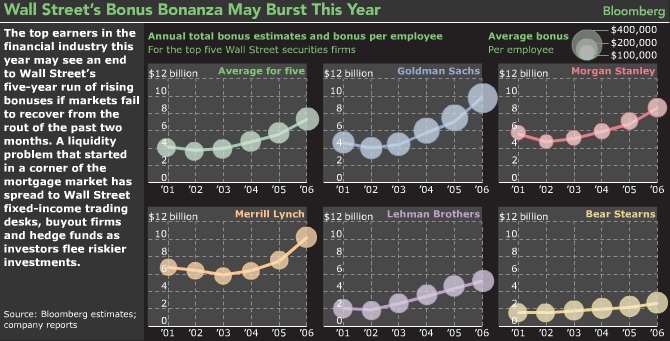
With only a few months left before financial firms begin their year-end payout discussions, it appears as though bonuses will not be nearly as lucrative as they have been in the recent past. I will be paying close attention to the results of Coach (NYSE: COH), Nordstrom (NYSE: JWN), and Sotheby’s (NYSE: BID) in the coming quarters. If their reports indicate that the wealthy have cut their spending, then overall US consumption could suffer an outright decline.
America is a highly indebted economy, which is not an issue if asset prices are rising. But if asset prices stop rising then servicing the debt becomes a problem and spending needs to be curtailed. Wal-Mart’s (NYSE: WMT) recent results show that low- and middle-income consumers are already tapped out. Expenditures from the high-income consumer may be the next shoe to fall.
