The August nonfarm payrolls data caught many people off guard when it showed the economy shed 4,000 jobs during the month. This was the first loss in 4 years. And to add insult to injury payrolls for June and July were revised down by a combined 81,000 jobs. The large revisions are one of the reasons I ignore the freshly reported payrolls figure.
Many bulls believe the economy will continue to perform well because unemployment is at very low levels which should lead to growth in wages and consumer spending.
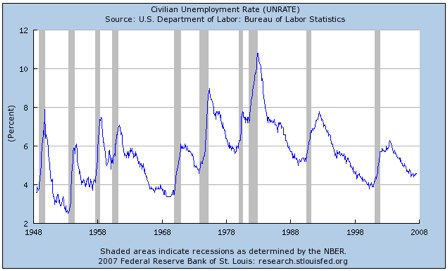
However, as the above chart shows, the unemployment rate is a coincident economic indicator. Therefore, when the unemployment rate is low, as it is now, it merely suggests that the economy has been doing well, but by the time we realize that it has reversed higher, the economy is already in a recession.
Also, the unemployment rate, by definition, may not give an accurate picture of employment. Here is how the unemployment rate is calculated:

The unemployment rate can decline when the number of people employed increases, which has been occurring based on the payrolls data of the last few years. But the unemployment rate can also fall when people leave the labor force, most likely due to difficulties in finding satisfactory work. The following graph plots the civilian employment – population ratio (EMRATIO) to strip out changes in the labor force.

Adam Oliensis makes the following comments regarding this chart:
What makes itself apparent to my eye is that any time the EMRATIO has fallen by as much as 0.5% from a local high it has fallen much further than that (usually 2-3%) and any time a fall of that magnitude has occurred there has been a recession.
The EMRATIO has now fallen about 0.6% since its peak in December 2006. So, if the “forces of nature” that have governed the economy continue to operate as they have over the past 50-60 years, it looks like we’re in for a larger fall in the EMRATIO (2-3%) and for a recession.
Interestingly, the EMRATIO, like the unemployment rate, has historically been a coincident indicator of economic growth. But this year the EMRATIO has been falling, while the government’s GDP report shows positive growth. Perhaps the GDP report would paint a recessionary picture if inflation was properly calculated. In any case, the EMRATIO debunks the bull case that the employment market is strong.
