The yen carry trade has been a major source of global liquidity since 2001 when Japan’s central bank cut rates to nearly zero while managing the US dollar-yen exchange rate. It’s intention was to stimulate Japan’s consumer spending and exports.
This policy allowed financial institutions to borrow funds from Japan and invest in assets offering higher returns such as emerging market equities and US bonds. For example, a hedge fund could borrow $100 million from Japan at 0.4% interest and use leverage to buy $1 billion short-term US treasury bonds yielding 5%. After one year, the hedge fund could close the bond position with $150 million. After paying off the loan in Japan it’s net profit would be close to $50 million and it would have earned a 50% return.
This assumes that Japanese interest rates don’t go up and the yen doesn’t appreciate. On January 18, the Bank of Japan decided not to raise rates and keep its key short-term rate at just 0.25%. With no signs that interest rates will rise anytime soon, the carry trade has picked up steam. According to a January 26 report by Barclays Capital the magnitude of yen-funded carry trades “is reaching scary levels” not seen since 1998.
Also, speculative short positions in the yen are at record levels:
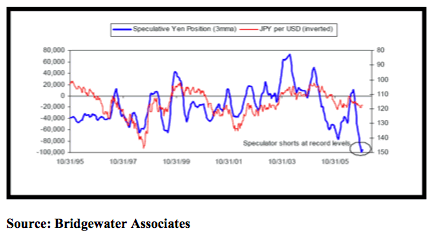
Being a contrarian, I suspect that the yen carry trade will still reverse in the near future. Although Japanese interest rates may not rise, the carry trade could become unprofitable if the yen started to appreciate against other currencies. This is possible if Japan’s economy strengthens leading to greater corporate profits and rising equity prices. Then the Japanese stock market, which was one of the wost performing stock markets last year, would begin to out-perform global assets. This would cause capital to return to Japan and the yen to appreciate.
Another possibility is that the weakness in the US housing market causes consumer spending to taper off and the economy to slow down. In response, the Fed would cut rates which would cause inflation to accelerate and the bond market to decline. The US dollar would weaken making a major portion of carry trades that borrow yen to invest in US bonds unprofitable. Hedge funds would then be forced to cut losses and return the capital to Japan causing the yen to appreciate further. This would lead to a reversal of carry trades that invest in assets in other parts of the world. In the end, global asset prices could plummet.
Of course sudden and unexpected non-economic events could also blow up the yen carry trade. Possible triggers include an escalation in Middle East tensions, major terrorist attacks or a bird-flu pandemic.
Last spring the world got a taste of how bad asset markets could falter when the Bank of Japan announced its intention to abandon the zero interest rate policy. The yen appreciated against the US dollar by 8% during April and mid-May. Hedge funds began to unwind the carry trade in May and the ensuing sell-off in asset prices continued through mid-June. The S&P 500 fell by 5%, Japan’s Nikkei fell by 17%, most emerging markets’ equities fell by 20-30%, gold fell by 22%, and copper fell by 21%.
In late 1998 Russia’s debt default accelerated the implosion of Long-Term Capital Management LP and caused a panic in markets. Investors scaling back their carry-trade positions drove the yen up 20 percent in less than two months.
The best way to play this is to go long yen. Since I don’t trade futures I intend to simply sit on the sidelines and watch as asset prices fall. Hopefully, gold will also correct which would present an opportunity to buy some of my favorite gold stocks cheaper than today.
