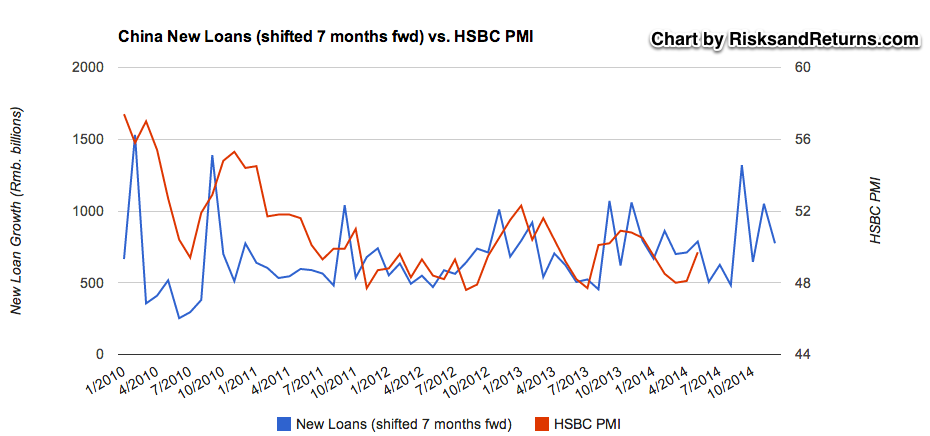
While China’s economy has slowed down from over 10% in 2010 to 7.4% last quarter, economists unanimously believe growth will soon bottom around 7% and maintain that pace for the next several years. As I will discuss, China’s economy is structured in such a way to make that forecast implausible. More likely, China will continue to decelerate for a few more years after which growth will bottom in the low single digits.

To understand why, it is important to recognize that the high economic growth rate China enjoyed for years was fuelled by a massive credit bubble that is unsustainable and must burst at some point in the next few years. In fact, debt has now grown to a point which has historically tipped countries into painful recessions.

Unlike most western countries, where consumption is the largest source of demand, in China it is fixed asset investment which comprises 50% of the economy and rising. Meanwhile, consumption and net exports are continuing to shrink as a proportion of the economy.

To appreciate the significance of this, imagine if investment stagnates during 2014 while the rest of the economy grows at the same rate as in 2013. Then China’s GDP would drop from 7.7% to 3.8% – a sharp deceleration that most would call a hard landing. Therefore, the only way policymakers can rebalance the economy away from investment and towards more consumption without causing a recession is by having investment growth slow at a gradual pace at the same time consumption growth accelerates.
In practice, there are two reasons why this soft landing handoff between investment and consumption is unlikely. First, real estate investments are an especially important sector of the Chinese economy accounting for one-third of total fixed asset investment and 16% of GDP.

And real estate loans make up 20% of total outstanding loans.

The problem is that home prices, particularly in tier 1 cities, are among the most expensive in the world relative to peoples incomes.

Also, there has been a significant overbuilding of apartments particularly in lower tier cities leading to inventory that will take years to clear out in a normalized demand environment,

Home prices have risen strongly over the past decade. but an inevitable correction in the property market, which serves as collateral for property loans, would cause widespread defaults, a banking crisis, a plunge in real estate investment, and a hard landing for the economy. In other words, real estate investment will drop significantly during a downturn.

A second reason why investment could fall quickly is that credit bubbles require increasing amounts of credit to create each additional unit of GDP. This is because a lot of the borrowed money is being spent on wasteful projects that do not earn enough of a return to service the debt. This is certainly the case in China where credit growth has been exceeding GDP growth for a number of years. Thus, for China to avoid a sharper slowdown, debt has to keep growing at an accelerating pace.

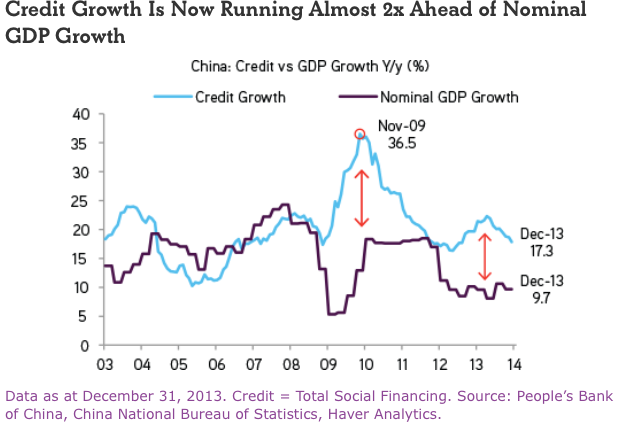
Unfortunately, 38% of GDP is required to service China’s corporate debt annually signifying that businesses are close to reaching their debt capacity.

And corporations are becoming less productive despite rising leverage.

This trend is not sustainable and in due time should lead to a surge in defaults and nonperforming loans for lenders. The knock on effect is a loss of business confidence leading to declining demand for and supply of credit, and a nasty drop in investment growth.
Most concerning is that China’s economy has already slowed down for three years straight, yet debt-to-GDP has continued to increase. When the economy actually deleverages, growth could decline more meaningfully leading to a financial crisis.
This would be problematic for the rest of the world because China has been the greatest contributor to global growth.

To conclude, I believe the biggest risk investors face in the coming years is a China recession. It will be important to monitor how effective Chinese policymakers will be in stimulating the economy and limiting turmoil in financial markets.