Last Friday I purchased fed funds futures contracts for November 2009 at 98.25. I went long fed funds futures earlier this year and closed the position in September with a huge gain. In retrospect, I could have made even more if I held on to the position, but I didn’t anticipate the Federal Reserve slashing the overnight rate by 100 basis points in October.
If I would have known in advance that October would be the ninth worst month in stock market history, the CRB index would register its largest monthly decline on record, and the US dollar would attain its biggest monthly gain against a basket of currencies in more than 17 years then, of course, I would have predicted the Fed’s policy decisions. But October was an unusual month to say the least.
What I find strange is that the market is pricing in only another 25 basis points cut by the next FOMC meeting on December 16th, after which the Fed is expected to embark on a tightening campaign next year by such an extent that the overnight rate would reach 1.75% by November.
I think only two conditions would necessitate such a policy response: (1) the US economy soon begins to stage a rapid recovery or (2) confidence in the US dollar is shaken and its value plummets. The first condition is highly unlikely, in my opinion, given that the US consumer is early in the process of decreasing consumption and increasing savings in order to repair his balance sheet from the damage done by declining real estate and equity values.
As for the possibility of a dollar crisis, I certainly expect one at some point in the future, but not in the next 12 months. The US dollar is the world’s reserve currency and in a period of de-leveraging, it will be in great demand. Only if the Fed prints money in a far more rapid fashion would confidence in the US dollar be shaken, and even then the Fed would have first resorted to a zero interest rate policy (ZIRP) for a period of time before attempting such a risky action.
During the last recession, the Fed began easing in January 2001 and didn’t raise rates until June 2004 or 41 months later. In the current cycle, the Fed first cut rates in September of last year or 14 months ago. If the Fed emulates its policy actions from the previous downturn then rates won’t increase until February 2011. I don’t know if the Fed will wait that long before it begins to hike rates, but given that the current recession will be far more severe than the previous recession, I am confident that there won’t be a hike in 2009.
Lowering of the fed funds rate helps the two groups most affected by the current crisis: banks and consumers. Banks benefit because their business is based on borrowing short and lending long, so their net interest margin will expand. Consumers benefit because many adjustable rate mortgages and loans are based on the banks’ prime rate which is influenced by the overnight rate. Therefore, there is a lot of incentive for the Fed to implement ZIRP.
However, I don’t think it will be enough to offer much of a stimulus for the economy because banks are barely solvent and don’t want to lend in order to preserve capital. And consumers have too much debt relative to the total value of their assets to want to borrow more. Therefore, credit growth, which factored in each time in the past as the Fed cut rates to pull the economy out of a recession has disappeared. Once the Fed cuts rates close to zero, it will realize that additional actions will be required.
Japan held rates at zero for nearly six years in its decade-long struggle against deflation. When that was not enough it resorted to “quantitative easing”, a technical term for what amounts to printing money on huge scale. I expect the Fed to follow the same game plan. Though it has already started to print money via its normal open market operations, I expect more aggressive money printing through unconventional means when it realizes ZIRP is not making much a difference.
The following table lists the profits or losses I would incur under various fed funds rates for each November 2009 contract that I buy at a price of 98.25:
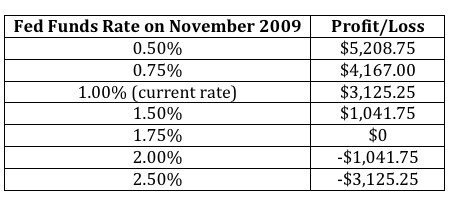
My intention is to hold the contracts until they rise to at least 99.50 (i.e. the market prices in a 0.50% fed funds rate or lower) so that I can make a profit of more than $5,000 per contract. This would be a spectacular return since the Chicago Board of Trade requires a maintenance margin of only $1,200 per contract.
