One year ago, I initiated a short position in MBIA (NYSE:MBI) based on a compelling presentation by hedge fund manager Bill Ackman. I shorted the stock at $61.29 and closed the position two months later at $46.47. My reasoning for ending the trade at the time was that MBIA had not disclosed in detail its CDO and RMBS exposures so in my mind there existed a possibility for MBIA to absorb the losses and survive. Unfortunately, shortly after closing out my position MBIA did provide more color on its insured structured finance portfolio and it wasn’t pretty. Before I could short the stock again, its price plummeted.
In April, I finally decided to pull the trigger and reopen my MBIA short position. Unfortunately, my broker was having difficulty locating stock to short. So I thought I would take advantage of the volatility of the stock price to sell MBIA January ‘09 calls with a strike price of $10 for $4 each. Until a few weeks ago I was sitting on a wonderful gain on this position as the options looked likely to expire worthless. However, recently MBIA’s share price has staged a miraculous recovery tripling to its current price of around $16 giving it a market cap of $4.4 billion for the first time since last November when its share price was $35 (MBIA has more than doubled its share count this year via secondary offerings).
Part of this rally is probably due to short covering as MBIA is one of the most heavily shorted stocks on the NYSE. But the ignition for the fire was provided by MBIA’s 2nd quarter earnings release as well as news that the company has reinsured a large public finance portfolio from FGIC. None of these events change my expectation that MBIA is going to face staggering losses in its structured finance portfolio that could render it insolvent. So last week I took advantage of the strength in the stock and sold some more January ‘09 calls, this time with a strike price of $15 for $3.30.
One’s opinion on whether MBIA is a buy or a sell largely depends on his macroeconomic outlook. If the current credit crisis begins to subside by early next year and the downturn in the economy is mild with a decent recovery similar to 2001, then defaults leading to claims in MBIA’s insured portfolio will not rise much from current levels and the company will return to positive operating cash flow by 2010. On the other hand, it is my belief that we are in the midst of the worst financial crisis since the Great Depression and a recession that will last beyond 2009. Personal and corporate bankruptcies will surge to levels not seen in decades and MBIA will be inundated with claims.
To conservatively estimate MBIA’s losses, I have assumed an outlook that is between the two that I have described above. Below are my estimates along with Bill Ackman’s from his Open Source Model.
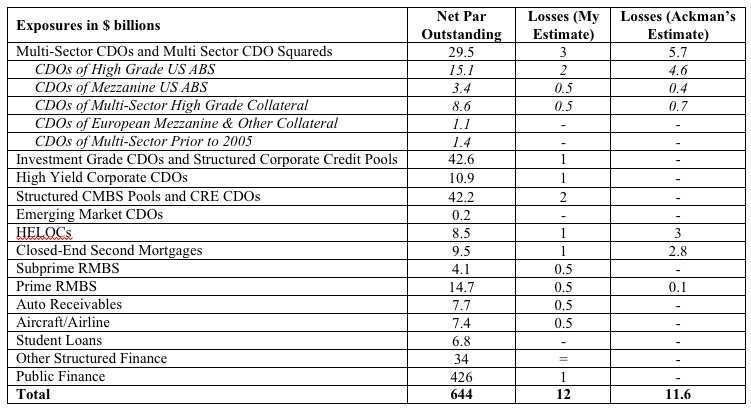
We both calculated a $12 billion loss. While he is projecting greater losses arising from MBIA’s multi-sector CDOs and second lien mortgages exposures, I am including additional losses in corporate CDOs, CMBS, auto receivables, student loans and public finance.
This is because I believe the current problems in the mortgage market are symptoms of a greater problem: a general mispricing of risk. Ultra-expansionary monetary policies conducted by the Federal Reserve in years past encouraged lenders to lend capital at terms and interest rates that didn’t adequately compensate them for the risk they were taking. This was prevalent in commercial real estate, corporate borrowing, consumer credit, municipal bonds, as well as the housing market. Now that the economy is likely in a recession, defaults will rise across the board.
Another risk MBIA faces is that it has reinsured $41.7 billion of its portfolio with Channel Re, a company which MBIA owns a minority stake in and counts MBIA as its only customer. Approximately half of the reinsured portfolio is comprised of CDOs meaning that ChannelRe is at a high risk of collapsing. If so, the reinsured policies would come back onto MBIA’s books. Using my estimate of approximately 6% loss on MBIA’s CDO exposure to calculate Channel Re’s loss on its $20 billion of CDO exposure results in a further loss to MBIA of $1 billion. Therefore, in total I expect $13 billion in losses.
If MBIA’s insurance subsidiary (MBIA Corp.) were to suffer $13 billion in losses, I don’t think it will be able to survive. MBIA would surely disagree and state that it has $16 billion in claim paying resources. The problem is that the losses will almost entirely come from structured finance credits which are of much shorter duration compared to public obligations. This means that MBIA would be swamped by claims over the next few years. As its capital base dwindles, its claims paying ratio would skyrocket resulting in further downgrades from the rating agencies. Basically, I don’t think the holding company and MBIA shareholders will receive another dividend from the insurance subsidiary.
The recent loss of MBIA’s triple-A status has resulted in an inability to write any new public finance policy of significance and the company has decided to withdraw from the structured finance business. Now its sole sources of cash flow are interest income and structured finance premiums on policies written in the past. (Premiums from public finance policies were paid upfront). Adding salt to the wound, the company’s 2nd lien mortgage exposures have resulted in a rising number of claims and a 2nd quarter that generated zero cash flow. If there are additional claims in the 3rd quarter MBIA will start burning cash. As the following chart suggests, 2nd lien RMBS claims have been surging over the past 3 quarters.
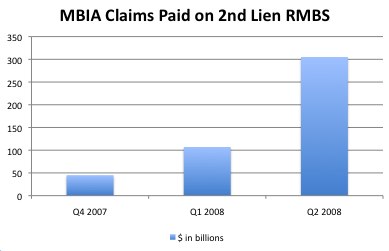
Surprisingly, MBIA is not expecting a significant further rise in claims as it has reserved only $796 million in RMBS losses (2% of RMBS gross net par) and $243 million in other losses. In addition, the company has only booked $1,040 million in impairments related to its CDO exposure (0.8% of its CDO gross net par). This is significantly lower than what the market thinks based on market prices or what investment banks have already accepted as losses. Is it possible that MBIA was more stringent in what it insured resulting in a portfolio of better quality? Not according to Ackman:
From 2005-2007, the total universe of ABS CDOs outstanding is comprised of approximately 534 deals. While MBIA and Ambac appear to have only limited direct exposure to this pool (having directly guaranteed only 25 and 28 CDOs, respectively), in fact, MBIA and Ambac are actually exposed to at least 420 and 389, respectively, of the 534 total CDOs outstanding if you include the CDO exposures within the CDOs they have guaranteed. The fact that MBIA and Ambac have direct or indirect exposure to 79% and 73%, respectively, of all ABS CDOs issued from 2005-2007 directly contradicts the insurers’ public statements about their “highly selective” approach to CDO guarantees.
The same can be said about MBIA’s RMBS exposure. So I don’t think the company has adequately reserved for future losses and once it does it will wipe out its capital base leading to additional downgrades.
A downgrade below AA would be problematic as it would require MBIA’s asset management subsidiary to terminate certain GICs issued to municipalities and post additional collateral on others. For example, a downgrade to triple-B would cause a maximum potential termination of $9.2 billion. This would force MBIA to liquidate at a loss most of its investment portfolio which includes instruments such CDOs and RMBS. The asset management subsidiary already has negative equity, so such a series of events would make it insolvent.
The only ray of hope for MBIA shareholders is if the holding company is successful in starting a new monoline insurance subsidiary with a triple-A rating. But I wouldn’t assign much value to this since the holding company’s balance sheet would have no equity if the investment in MBIA Corp. is excluded. So without much capital to infuse into a new insurance subsidiary, MBIA wouldn’t be able to write many policies. And considering the entry of Berkshire Hathaway as a competitor, the collapse of the structured finance market and the loss of interest in guaranteeing public credits I don’t think MBIA can make much money.
In conclusion, I think shorting MBIA or selling calls on it at today’s prices is an excellent speculative bet.
