In my previous post, I explained why the US Southwest is on the brink of facing a water crisis and why it is important that the large allocation of water for agriculture be shifted to residential and industrial use. There is one company which specializes in acquiring water rights from farmers and selling them to municipalities at a profit. That company is PICO Holdings (NASDAQ: PICO), which I own and view as an attractive value investment.
PICO operates four different businesses through subsidiaries:
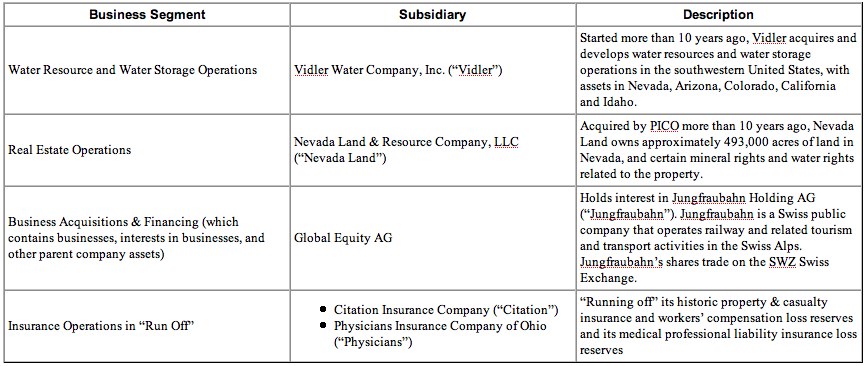
Most of PICO’s assets do not produce regular income, so the best way to value the company is on a book value basis. Using this measure, management has done a good job growing book value per share. In less than 5 years book value per share has increased by 56%.
2007/9/30 = $27.90
2006/12/31 = $25.52
2005/12/31 = $22.67
2004/12/31 = $19.40
2003/12/31 = $18.52
2002/12/31 = $17.86
But I believe PICO’s assets are worth much more than what’s stated on its balance sheet. To see how, let’s examine each of PICO’s business segments.
Water Resource and Water Storage Operations
For the last 10 years, PICO’s water resource development subsidiary, Vidler Water Company, has been accumulating and developing water rights in carefully chosen locations in Nevada and Arizona, in anticipation of the strong population growth and shortage of water that is occurring now. Vidler seeks to allocate its water supplies to municipal and industrial use in a way that maximizes profits. Vidler frequently operates in areas where rapid population growth occurs in municipalities that lack the financial or technical resources to develop new supplies of water.
The inefficient allocation of available water between agricultural users and municipal or industrial users, or the lack of available known water supply in a particular location, provide opportunities for Vidler:
- the majority of water rights are currently owned or controlled by agricultural users, and in many locations there are insufficient water rights owned or controlled by municipal and industrial users to meet present and future demand;
- certain areas of the Southwest experiencing rapid growth have insufficient known supplies of water to support future growth. Vidler identifies and develops new water supplies for communities with no other known water resources to support future growth. In certain cases, to supply water from the water resources identified by Vidler, it may require regulatory approval to import the water from its source to where development is occurring, or substantial infrastructure to convey the water. Vidler is able to assess the likelihood of being able to get the necessary approval to import water, and to build the infrastructure in a timely and economic manner. In cases where it assesses that water importation is possible, Vidler has demonstrated an ability to obtain all of the required approval and entitlements, and to manage the building of the infrastructure necessary to import and convey the identified water from its source to development; and
- currently there are not effective procedures in place for the transfer of water from private parties with excess supply in one state to end-users in other states. However, regulations and procedures are steadily being developed to facilitate the interstate transfer of water. Infrastructure to store water will be required to accommodate and allow interstate transfer, and transfers from wet years to dry years. Currently there is limited storage capacity in place.
Vidler is engaged in the following activities:
- supplying water to end-users in the Southwest, namely water utilities, municipalities, developers, or industrial users. The source of water could be from identifying and developing a new water supply, or a change in the use of water from agricultural to municipal and industrial; and
- development of storage and distribution infrastructure to generate cash flow from the purchase and storage of water for resale, and charging customers fees for “recharge,” or placing water into storage.
Vidler’s priority is to either monetize or develop recurring cash flow from its most important assets by:
- securing supply contracts utilizing its water rights in Nevada; and
- storing additional water at the Vidler Arizona Recharge Facility, and providing water supplies from net recharge credits (a recharge credit is an acre-foot of water) already in storage.
Vidler has also entered into “teaming” arrangements with parties who have water assets but lack the capital or expertise to commercially develop these assets. The company only extends capital in those areas where initial investigations indicate that obtaining a sufficient quantity of water provides an adequate return on the capital employed in the project. These capital expenditures largely consist of drilling and engineering costs for water production, costs of monitoring wells, and legal and consulting costs for hearings with the State Engineer, and National Environmental Protection Act, or “NEPA”, compliance costs. The first such arrangement is a water delivery teaming agreement with Lincoln County (“Lincoln/Vidler”), which is developing water resources in Lincoln County, Nevada. The following details Vidler’s water rights and water storage assets:
1. Fish Springs Ranch
Vidler owns a 51% interest in the Fish Springs Ranch which contains 13,000 acre-feet of permitted water rights. The company is near completion of constructing a pipeline that could convey 8000 acre-feet of water from the Fish Springs Ranch to a central storage tank in northern Reno, Nevada. Reno is constrained for land that could be developed for residential use because of a lack of water supplies. As a result, the market price of water delivered to Reno has strongly appreciated recently. Once the pipeline is completed, Vidler will seek to sell the water to developers in the northern valleys. The company has already agreed to sell approximately 117.5 acre-feet of water for $45,000 per acre-foot.
The total cost of the pipeline is approximately $90 million, $75 million of which Vidler has already capitalized. In accordance with the Fish Springs partnership agreement, the other partner’s share of the cost is 49% which Vidler will pay, but will be recouped from the net revenues generated from the sale of water from Fish Springs. Therefore, if Vidler is able to sell the remaining water rights for $45,000 (which the company believes is likely) then Vidler’s share of total revenues of $360 million will be approximately $205 million. This would amount to a net increase in book value of approximately $80 million.
2. Lincoln County
The Lincoln County Water District and Vidler (“Lincoln/Vidler”) have entered into a water delivery teaming agreement to locate and develop water resources in Lincoln County, Nevada. Under the agreement, proceeds from sales of water will be shared equally after Vidler is reimbursed for the expenses incurred in developing water resources in Lincoln County. Lincoln/Vidler has filed applications for more than 100,000 acre-feet of water rights with the intention of supplying water for residential, commercial, and industrial use, as contemplated by the County’s approved master plan. This is the only known new source of water for Lincoln County. Vidler anticipates that up to 40,000 acre-feet of water rights will ultimately be permitted from these applications, and put to use for projects in Lincoln County.
Under the Lincoln County Land Act, more than 13,300 acres of federal land in southern Lincoln County near the fast growing City of Mesquite was offered for sale in February 2005. According to press reports, the eight parcels offered sold to various developers for approximately $47.5 million. The land was sold without environmental approvals, water, and city services, which will be required before development can proceed. Additional water supply will be required in Lincoln County if this land is to be developed.
In 1998, Lincoln/Vidler filed for 14,000 acre-feet of water rights for industrial use from the Tule Desert Groundwater Basin. In November 2002, the Nevada State Engineer granted an application for 2,100 acre-feet of water rights, and ruled that another 7,244 acre-feet could be granted, but would be held in abeyance while Lincoln/Vidler pursues additional studies.
In 2005 Lincoln/Vidler entered into an agreement with a developer. The developer has up to 10 years to purchase up to 7,240 acre-feet of water, as and when supplies are permitted from the applications. It is expected that the hearings to permit these applications will commence in 2007. During 2006, Vidler successfully drilled a series of production and monitoring wells to provide evidence to support the applications. The initial price of $7,500 per acre-foot will increase at 10% each year. In addition, the developer pays a commitment fee equal to 10% of the outstanding balance of unpurchased water each year, beginning August 9, 2006, which will be applied to the purchase of water. If the 40,000 water rights that are expected to be permitted in Lincoln County are valued at a conservative $5000 per-acre feet and we assume that it cost Vidler $500 per-acre feet to develop them, then Vidler’s share of the value of the water rights would amount to an increase in book value of $80 million.
3. Vidler Arizona Recharge Facility
During 2000, Vidler completed the second stage of construction at its facility to “bank,” or store, water underground in the Harquahala Valley, and received the necessary permits to operate a full-scale water “recharge” facility. “Recharge” is the process of placing water into storage underground. Vidler has the permitted right to recharge 100,000 acre-feet of water per year at the Vidler Arizona Recharge Facility, and anticipates being able to store in excess of 1 million acre-feet of water in the aquifer underlying much of the valley. When needed, the water will be “recovered,” or removed from storage, by ground water wells.
The Vidler Arizona Recharge Facility is the first privately owned water storage facility for the Colorado River system, which is a primary source of water for the Lower Division States of Arizona, California, and Nevada. The water storage facility is strategically located adjacent to the Central Arizona Project (“CAP”) aqueduct, a conveyance canal running from Lake Havasu to Phoenix and Tucson. The water to be recharged will come from surplus flows of CAP water. The proximity to the CAP is a competitive advantage, because it minimizes the cost of water conveyance.
Vidler is able to provide storage for users located both within Arizona and out-of-state. Potential users include industrial companies, developers, and local governmental political subdivisions in Arizona, and out-of-state users such as municipalities and water agencies in Nevada and California. The Arizona Water Banking Authority (“AWBA”) has the responsibility for intrastate and interstate storage of water for governmental entities.
Vidler has the only permitted, complete private water storage facility in Arizona. Given that Arizona is the only southwestern state with surplus flows of Colorado River water available for storage, we believe that Vidler’s is the only private water storage facility where it is practical to “bank,” or store, water for users in other states, which is known as “interstate banking.” Having a permitted water storage facility also allows Vidler to acquire, and store, surplus water for re-sale in future years.
Vidler has not yet stored water for customers at the recharge facility, and has not as yet generated any revenue from the facility. Vidler has been recharging water for its own account since 1998, when the pilot plant was constructed. At the end of 2006, Vidler had “net recharge credits” representing approximately 115,000 acre-feet of water in storage at the facility, and had purchased or ordered a further 30,000 acre-feet for recharge in 2007. Vidler purchased the water from the CAP, and intends to resell this recharged water at an appropriate time.
Vidler anticipates being able to recharge 35,000 acre-feet of water per year at the facility, and to store in excess of 1 million acre-feet of water in the aquifer. Vidler’s estimate of the aquifer’s storage volume is primarily based on a hydrological report prepared by an independent engineering firm for the Central Arizona Water Conservation District in 1990, which concluded that there is storage capacity of 3.7 million acre-feet.
Recharge and recovery capacity is critical, because it indicates how quickly water can be put into storage or recovered from storage. In wet years, it is important to have a high recharge capacity, so that as much available water as possible may be stored. In dry years, the crucial factor is the ability to recover water as quickly as possible. There is a long history of farmers recovering significant quantities of water from the Harquahala Valley ground water aquifer for irrigation purposes.
Vidler is in discussions with a number of developers and other entities which could lead to the sale of net recharge credits. The company believes that the storage site, the net recharge credits, and Vidler’s remaining water rights and land in the Harquahala Valley could be an attractive combination to developers looking to secure water supply to support new development in the Harquahala Valley, which is approximately 75 miles northwest of metropolitan Phoenix, Arizona.
The Vidler Arizona Recharge Facility is located in La Paz County, close to the county line with fast-growing Maricopa County. According to U.S. Census Bureau data, the population of Maricopa County increased 18.3% from 2000 to 2005, with the addition of more than 110,000 people per year. Vidler anticipates that as the boundaries of the greater Phoenix metropolitan area push out, this is likely to lead to demand for water to support growth within the Harquahala Valley itself. Vidler’s 115,000 acre-feet of net recharge credits should easily generate proceeds of $300 above its costs on a per acre-foot basis. Thus, the Vidler Arizona Recharge Facility could be worth $30 million more than its balance sheet value.
Real Estate Operations
In April 1997, PICO paid $48.6 million to acquire Nevada Land, which at the time owned approximately 1,352,723 acres of deeded land in northern Nevada, and the water, mineral, and geothermal rights related to the property. Much of Nevada Land’s property is checker-boarded in square mile sections with publicly owned land. The lands generally parallel the Interstate 80 corridor and the Humboldt River, from Fernley, in western Nevada, to Elko County, in northeast Nevada.
Nevada Land is one of the largest private landowners in the state of Nevada. According to U.S. Census Bureau data, Nevada has experienced the most rapid population growth of any state in the United States for 19 of the past 20 years, being narrowly edged out by Arizona in 2006. The population of Nevada increased 66% in the 10 years ended April 1, 2000, and increased another 25%, to approximately 2.5 million people, from 2000 to 2006. Most of the growth is centered in southern Nevada, which includes the city of Las Vegas and surrounding municipalities. Land available for private development in Nevada is relatively scarce, as governmental agencies own approximately 87% of the land in Nevada.
Before the acquisition of Nevada Land, the property had been under the ownership of a succession of railway companies, to whom it was a non-core asset. Accordingly, PICO believes that the commercial potential of the property had not been maximized. During the period from April 23, 1997 to September 30, 2007, Nevada Land received consideration of approximately $70.1 million from the sale and exchange of land, and the sale of water rights. This is comprised of $69 million from the sale and exchange of land, and $1.1 million from the sale of water rights related to land that was sold.
Over this period, approximately 814,000 acres of land was divested at an average price of $85 per acre, which compares to an average cost basis of $35 in the acres disposed of. The average gross margin percentage on the disposal of land and water rights over this period is 59.6%. The average cost for the total land, water, and mineral assets acquired with Nevada Land was $35 per acre. Currently, Nevada Land owns approximately 560,000 acres of land. In light of the recent downturn in Nevada property prices, it is reasonable to assume that Nevada Lands real estate would be worth at least $35 per acre above its cost basis. And if sold, PICO’s book value would increase by $20 million.
At December 31, 2006, Nevada Land owned approximately 541,000 acres of former railroad land. In addition to the former railroad property, Nevada Land acquired:
- 17,558 acres of land in a land exchange with a private landowner. This land is contiguous with Native American tribal lands and is culturally sensitive; and
- Spring Valley Ranches, which originally consisted of 8,717 acres of deeded land, located approximately 40 miles east of Ely in White Pine County, Nevada. During 2006, we sold approximately 7,675 acres of land and related water assets at Spring Valley.
In recent years, Nevada Land has filed additional applications for approximately 50,600 acre-feet of water rights on the Company’s former railroad lands. Of these applications, approximately 12,400 acre-feet of water rights have been certificated and permitted, and applications are pending for approximately 38,200 acre-feet of water use for agricultural, municipal, and industrial use. Potentially, some of these water rights could be utilized to support the growth of municipalities in northern Nevada.
Insurance Operations in Run-off
This segment consists of Physicians Insurance Company of Ohio and Citation Insurance Company. Both Physicians and Citation are in “run off.” This means that the companies are handling and resolving claims on expired policies, but not writing new business.
Typically, most of the revenues of an insurance company in “run off” come from investment income (i.e., interest from fixed-income securities and dividends from stocks) earned on funds held as part of their insurance business. In addition, from time to time, gains or losses are realized from the sale of investments.
In broad terms, Physicians and Citation hold cash and fixed-income securities corresponding to their loss reserves and state capital & deposit requirements, and the excess is invested in small-capitalization value stocks in the U.S. and selected foreign markets.
Equity Investments
PICO holds $263.5 million worth of marketable equity securities. The most significant holding is Jungfraubahn Holding AG, which has a market value and carrying value of $68.9 million (before taxes). PICO is the largest shareholder by owning 1.3 million shares of Jungfraubahn, which represents approximately 22.5% of that company. At June 30, 2007, Jungfraubahn had shareholders’ equity of CHF 341.6 million or approximately CHF 58.55 (US$53.28) in book value per share. At December 31, 2007, Jungfraubahn’s stock price was CHF 58.00 (US$52.78).
PICO’s $200 million-plus is invested in other publicly listed companies that are also trading at around book value. This value approach to investing should insulate the company’s portfolio from severe declines and in the long-term should lead to steady capital appreciation.
In sum, PICO’s book value could increase by around $210 million over the next few years as the company unlocks value from its real estate and water assets. This is equal to a share price of $39, which makes the company’s shares attractive at its current market price of $33. And if the US Southwest undergoes a water crisis, which I’m afraid is quite likely, then PICO’s stock price should soar. Thus, PICO makes for both a good value investment and a bet on water.
