As I explained in a previous post, China has a massive credit bubble that inevitably will deflate. Almost always the onset of debt deflation causes a market panic as disappointed investors run for the exits fearing falling asset prices, bankruptcies, and a sharp economic slowdown. I believe there is an elevated risk that China could face a Minsky moment in the coming months.
There are several reasons that make me fearful of a China induced market panic this summer. First, new loan growth has been a good leading indicator for economic growth. As shown in the chart below, new loan growth really dropped off in the fourth quarter of last year signalling a deepening economic slowdown in the next few months. Interestingly, new loans picked up significantly in the first quarter, so the economy could experience a temporary rebound in the second half of the year.
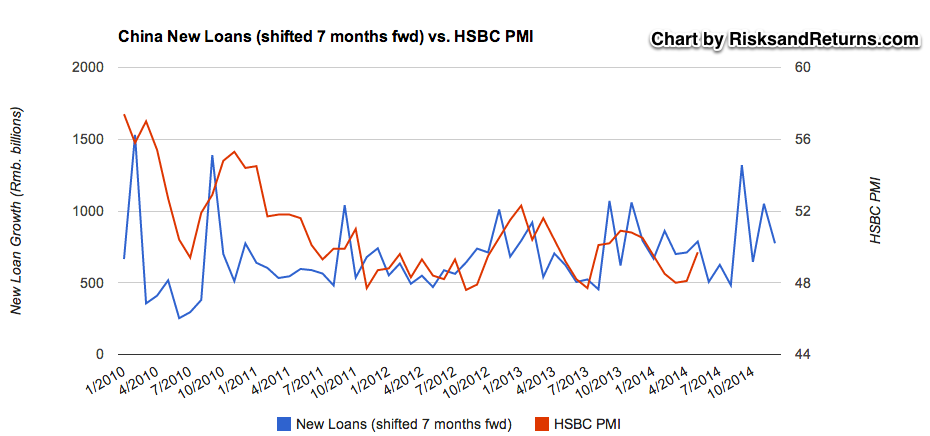
Second, China’s property market has cooled considerably in recent months and prices are no longer rising. This is important because property serves as collateral for 20% of all loans. As a consequence, credit growth could slow and non-performing loans at banks could spike higher.

Chinese corporations were already struggling to manage its debts. Currently, more than one-third of China’s GDP is needed just to service the debt.

Third, to make matters worse, a large wave of debt is coming due in the next few months. Though systemically important companies will be bailed out, many others will face default.

As a chilling reminder, the US financial crisis began when the initial wave of mortgage resets hit in early 2008.

The final reason why China could cause a market dislocation during the summer is that Chinese officials seem to recognize the negative effects of the the large scale stimulus implemented in 2009, and they have openly stated that no large stimulus measures will be forthcoming. Speaking at the annual Boao Forum for Asia on April 10, Premier Li firmly rejected stimulus remedies.
We will not resort to short-term stimulus policies just because of temporary economic fluctuations, and we will pay more attention to sound development in the medium and long run.
I suspect financial conditions will have to get a lot worse before officials backtrack and aggressively stimulate. If so, the following scenario could unfold during the year: economic data from China is reported that badly misses expectations, growth estimates get cut, several companies and wealth management products miss debt repayment deadlines, interest rates fall further on deflationary concerns, the US dollar and Japanese yen surge higher, and stock markets around the world fall by 10%-25% within weeks.
If indeed the Chinese economy disappoints and stocks sell off, I would expect a series of reserve ratio cuts by the PBOC. This monetary easing along with the delayed reaction to the 1st quarter lending surge and mini stimulus announced in April should help the economy to experience a temporary rebound later in the year and halt any market panic.
In the meantime, investors would be wise to raise some cash and hedge their portfolios just in case China causes a temporary panic sell off in global markets.
